Some Trends Are Artifacts of Ignored Autocorrelation
Long time series contain memory. If that dependence is ignored, apparent accelerations, breakpoints, and regime shifts can look more certain than the evidence allows.
- Reference
- notes:n13
- Published
- 2026.04.19
- Series
- note
- Source
- Source ↗
Long time series have become central to the detection of change. From climate warming and ecological variability to public-health surveillance, researchers use observations spanning decades to ask whether a system is accelerating, slowing, crossing a breakpoint, or moving into a new regime.
But a long time series is not a collection of independent observations. Adjacent periods often carry persistence: a high or low value at one time point influences the next. The series has memory. Trend interpretation therefore cannot rest on a smooth-looking rise or fall alone; it must account for the correlation structure within the observations.
Beaulieu et al. addressed this problem directly in their 2024 Communications Earth & Environment paper, A recent surge in global warming is not detectable yet. The question was whether a new acceleration in global warming after the 1970s could already be identified statistically with confidence.
The authors fitted changepoint models to four global mean surface-temperature records, explicitly modelling first-order autocorrelation and distinguishing continuous from discontinuous segmented-trend formulations. In the continuous model—the form they considered more physically plausible—all four datasets identified only one major changepoint, near 1970. Even the discontinuous models did not support a new change in warming rate after the 1970s. Once temporal autocorrelation was included, the available observations did not provide enough evidence for a statistically distinct recent acceleration.
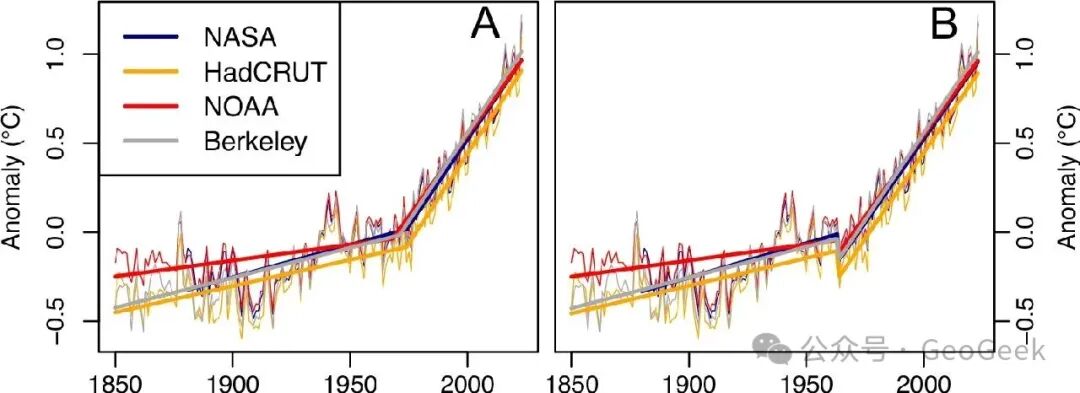
Figure 1 · Results from continuous models that account for temporal autocorrelation. All four global mean surface-temperature series identify one principal changepoint around 1970 and do not detect a subsequent change in the warming rate.
What happens if autocorrelation is ignored? The paper constructs a useful counterexample. On the HadCRUT series, the authors fitted a discontinuous segmented model that assumed independent errors. The result looked impressively detailed: it detected the acceleration of the 1970s, an additional phase change around 2000, and another acceleration around 2012.
Viewed as a figure alone, such a result could easily be interpreted as evidence that the climate trend had entered several distinct new phases. But the residuals of this model remained strongly positively correlated. The independence assumption was false, and a formal test gave extremely strong evidence against it, with p < 0.000008.
The additional breakpoints were therefore not robust discoveries. They were false detections created by treating correlated fluctuations as independent information. When persistent deviations are counted as if each were a new piece of evidence, statistical significance is inflated and changepoint algorithms can manufacture apparently clear transitions that the data do not actually support.
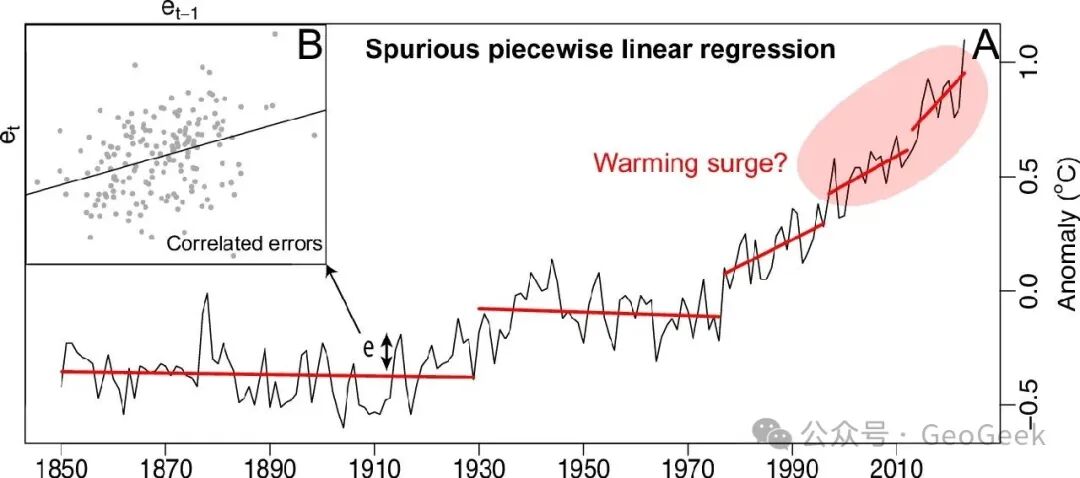
Figure 2 · The illusion produced by ignoring temporal autocorrelation. Panel A shows several post-1970 changepoints detected by a segmented model with independent errors; panel B shows significant positive residual autocorrelation. Because the model's central independence assumption fails, the additional changepoints are spurious detections.
The statistical lesson is basic but consequential: when a time series has memory, trend detection has to model short-term dependence correctly. Ignoring autocorrelation is not a minor technical simplification. It can change the scientific conclusion itself, generating unsupported breakpoints, regime shifts, or apparent accelerations.
Reference
- Beaulieu, C., Gallagher, C., Killick, R. et al. A recent surge in global warming is not detectable yet. Communications Earth & Environment 5, 576 (2024). doi:10.1038/s43247-024-01711-1.