Can Satellites and AI Reveal “Maxwell Equations” for the Earth System?
A Wuhan University perspective proposes a planetary laboratory in which global satellite observations and AI are used to search for compact, interpretable laws of Earth-system behaviour.
- Reference
- notes:n14
- Published
- 2026.04.15
- Series
- note
- Source
- Source ↗

Wuhan University professors Lian Feng and Deren Li recently published a Perspective in National Science Review titled Can Satellites and AI Reveal the Maxwell Equations of the Earth?. The paper proposes combining global satellite observations with artificial intelligence to treat the Earth as a continuously operating planetary-scale laboratory.
The analogy is deliberately ambitious. Maxwell's equations unified electrical and magnetic phenomena that had previously appeared separate. The Earth-system question is whether similarly compact, interpretable relations might eventually be found for the coupled dynamics of climate, ecosystems, and human activity.
The authors argue that global Earth observation and AI together could make it possible to mine the spatiotemporal structure of land and environmental variables and, from that evidence, search for interpretable equations describing key processes such as the water cycle, carbon cycle, and energy exchange. The aim is not simply a larger predictive model, but a framework for discovering regularities in a complex coupled system.
If successful, this approach could provide a new theoretical route for Earth-system understanding and contribute to prediction, climate research, and sustainability governance. The original article is available at doi:10.1093/nsr/nwag210.
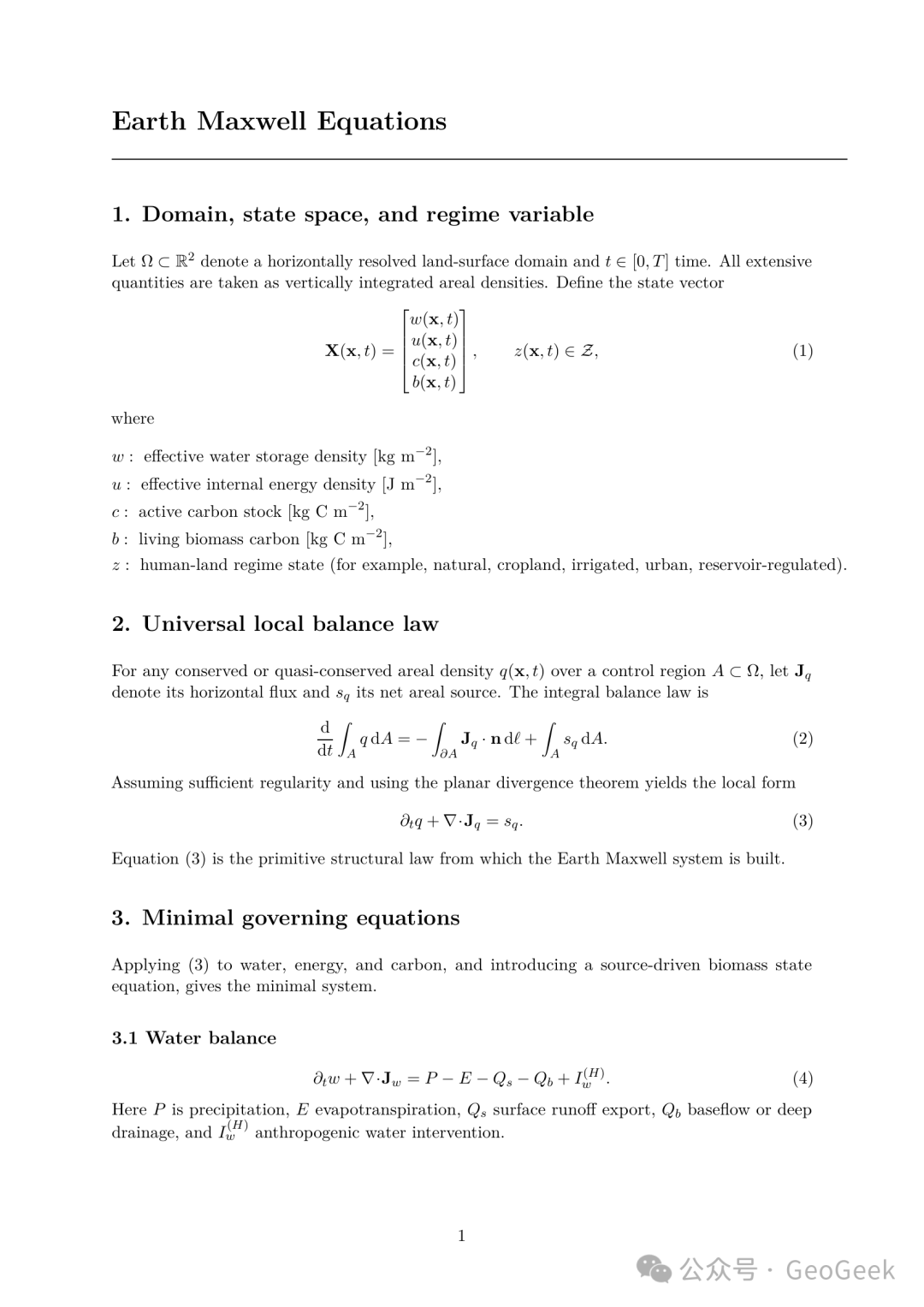
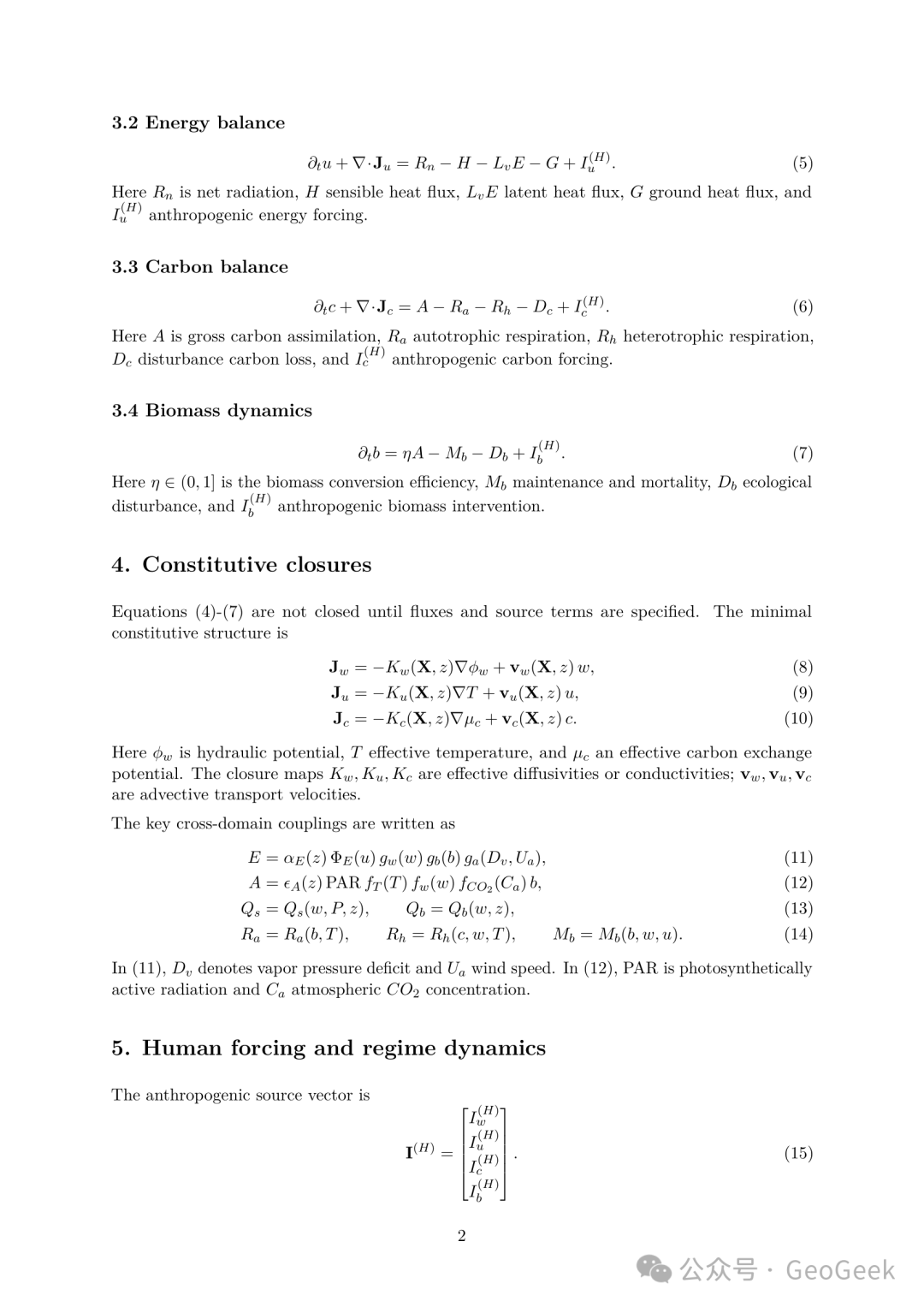
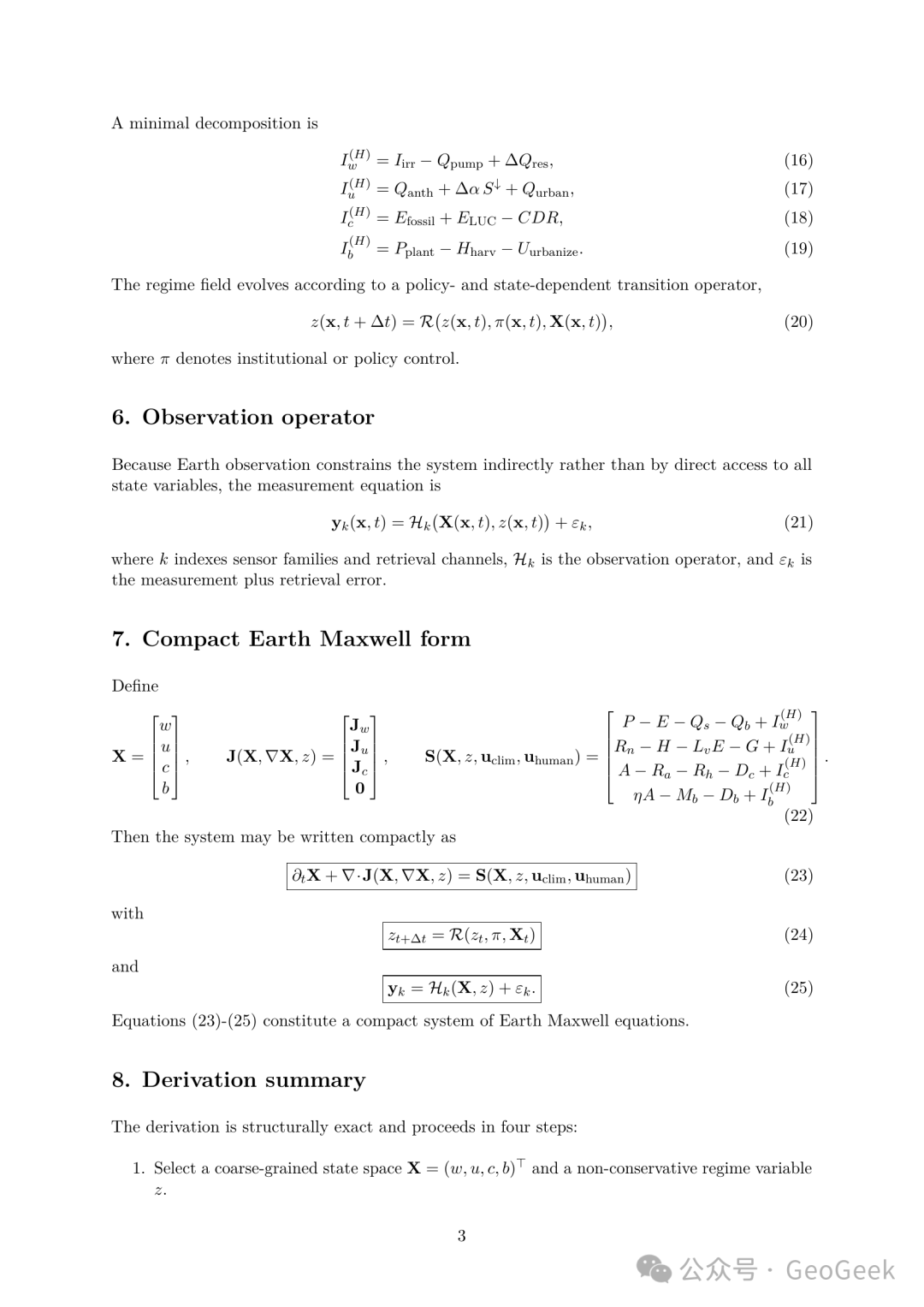
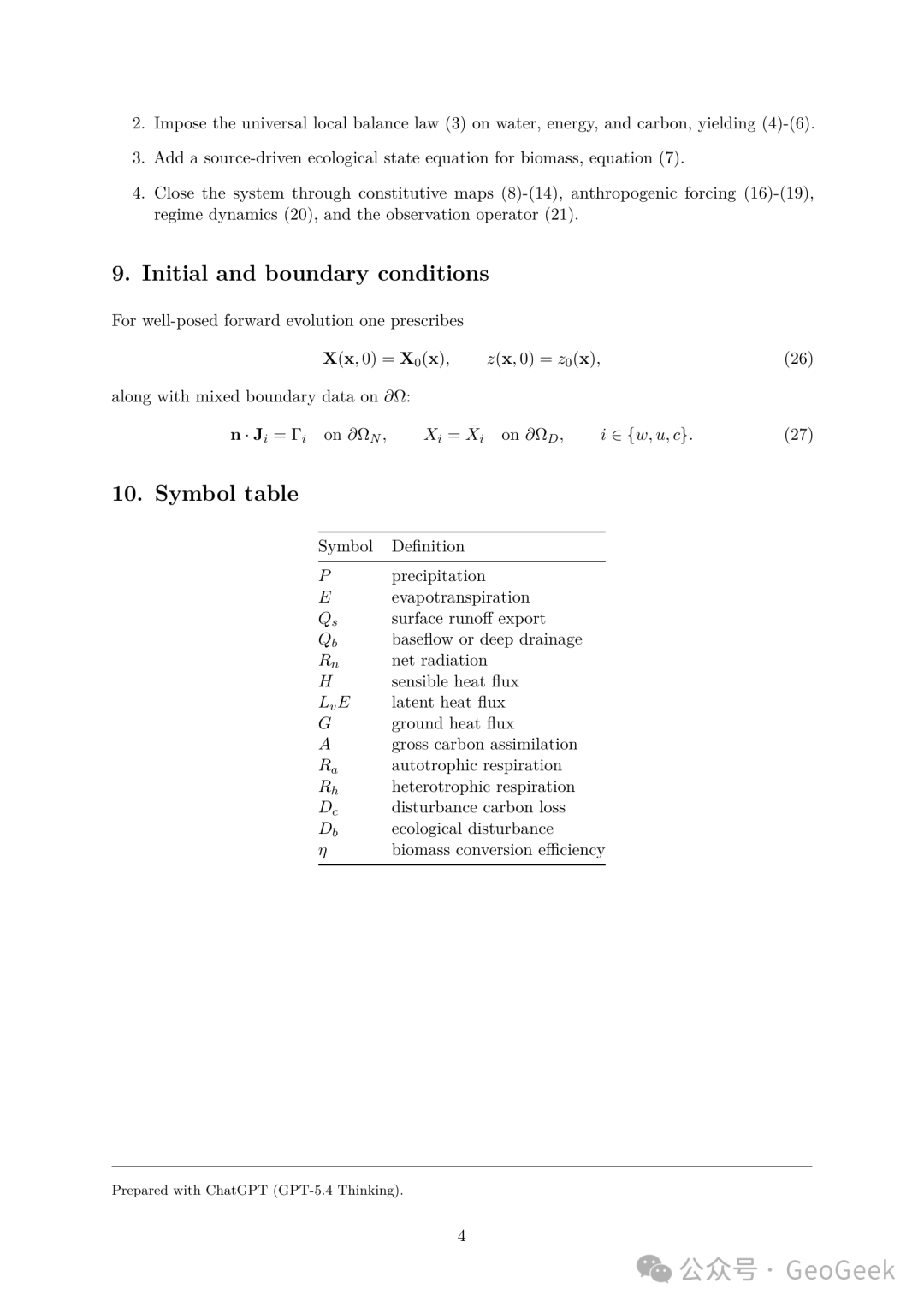
A thought experiment: what might “Earth Maxwell equations” look like?
After reading the Perspective, I tried a deliberately speculative exercise. If one were forced to sketch a conceptual set of “Earth Maxwell equations,” what would the modelling architecture look like? I used an AI model to test how far a structured derivation could be pushed.
The generated modelling path began by selecting a small set of core Earth-system state variables: water, energy, carbon, and biomass, corresponding broadly to the hydrologic cycle, energy balance, carbon cycle, and ecological structure.
For each state variable, the next step was to impose a local conservation framework: any change has to be explained by transport and by sources or sinks. Flux terms, source–sink terms, and cross-process coupling terms could then be introduced so that evapotranspiration, radiation, photosynthesis, respiration, runoff, and related processes are no longer represented as isolated components but as coupled dynamics.
Human activities—irrigation, emissions, land-use change, management, and institutions—would enter as external forcings or explicit societal variables, recognizing the Earth system as a coupled human–natural system rather than a purely biophysical one.
Finally, satellite observation equations would connect the latent physical state to measurable signals. That step matters because a useful unified framework must not only express processes; it must remain continuously constrained, inverted, and tested against global observations.
The resulting conceptual skeleton therefore consists of state, conservation, coupling, human forcing, and observation constraints. The exercise was speculative, but the sequence itself follows a familiar Earth-system modelling logic: define the state variables, impose conservation as the backbone, then add process coupling, human influence, and observation operators.
Remote sensing and AI are advancing quickly enough that the search for more compact, discoverable Earth-system regularities no longer feels purely rhetorical. Whether those regularities can approach the conceptual economy of Maxwell's equations is an open scientific question. The interesting part is that global observation now gives us a scale of empirical constraint that earlier generations did not have.
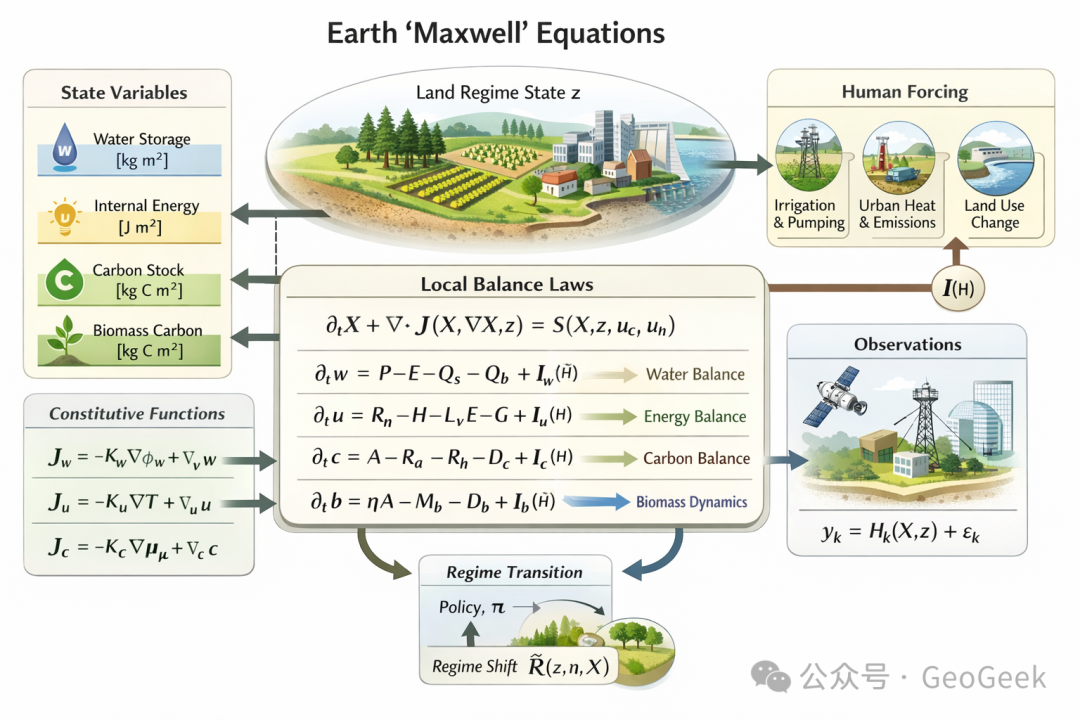
Figure 1 · Conceptual “Earth Maxwell Equations” framework. Water, energy, carbon, and biomass states evolve under biophysical transport, ecological coupling, human forcing, land-use change, and observation constraints. This figure was generated with ChatGPT as part of the thought experiment and is not from the original Perspective.