Long Remote-Sensing Records and the Problem of Temporal Consistency
A decades-long satellite series is rarely one instrument watching continuously. Sensor changes, orbit drift, calibration, fusion, and processing can create trends that look environmental.
- Reference
- notes:n15
- Published
- 2026.04.13
- Series
- note
- Source
- Source ↗
Every so often, a major paper in Nature or Science uses several decades of satellite data to tell us that the Earth is undergoing an important change: global vegetation continues to green, forest-restoration potential has been revised, or ecosystems are becoming less responsive to rising atmospheric CO₂.
What ultimately determines whether such findings hold is often not the scale of the conclusion, but a more basic issue that sits behind it: temporal consistency in remote-sensing data.
Remote sensing is often imagined as a camera in orbit that has been recording the Earth continuously for decades. Long records are usually more complicated. The AVHRR series, for example, is not the output of one sensor on one satellite. It is assembled from a succession of NOAA satellites observed under different orbital conditions and geometries. Later parts of the record are often stitched to, or harmonized with, newer sensors such as MODIS.
Researchers therefore do not work with one instrument's uninterrupted “raw video” of the planet. They work with a long record assembled from different sensors, orbital histories, view geometries, calibration states, and fusion procedures. Before asking what such a series says about the Earth, a more elementary question has to be answered: are observations from its beginning and end genuinely comparable?
If that question is not addressed, an apparently coherent multidecadal change can reflect the continuity of a processing chain as much as the continuity of the Earth process itself.
01 · A reported decline in the global CO₂ fertilization effect
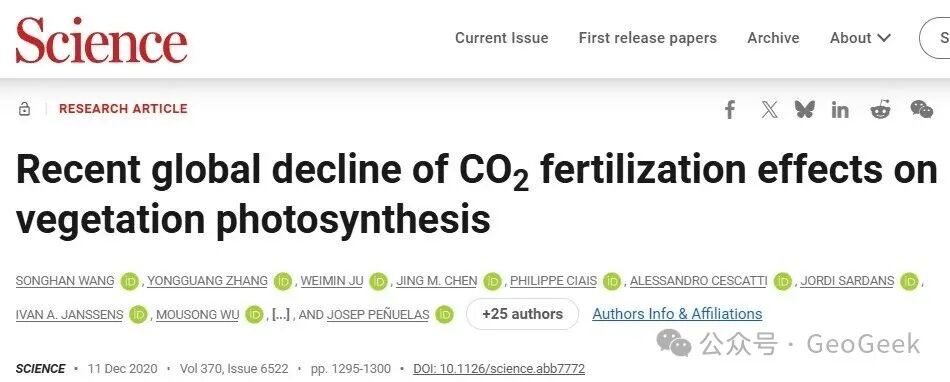
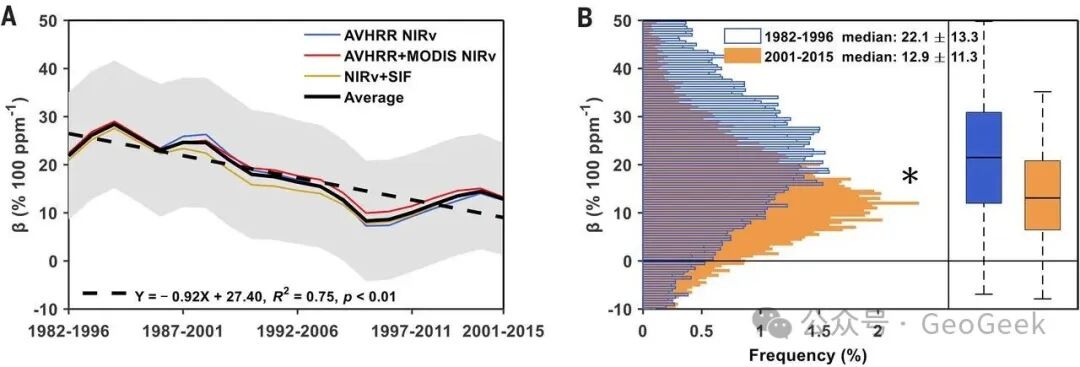
In 2020, Wang et al. published Recent global decline of CO₂ fertilization effects on vegetation photosynthesis in Science. They argued that between 1982 and 2015 the strength of the vegetation-photosynthesis response to rising atmospheric CO₂—the CO₂ fertilization effect, or CFE—declined globally.
The result attracted broad attention. If vegetation is becoming less responsive to additional CO₂, expectations about the terrestrial carbon sink, the global carbon cycle, and future climate feedbacks may need to be revised.
Figure 1 · Temporal change and distributional shift in β. Using three satellite-derived proxies for GPP, Wang et al. estimated β in 15-year moving windows and compared its distribution between 1982–1996 and 2001–2015. The estimated β declined at the global scale (Wang et al., 2020).
The finding depended critically on long-term remote-sensing records, but CFE itself was not directly measured by a satellite. The analysis combined long-term vegetation proxies and environmental variables in a statistical regression, estimated a parameter β as the strength of the photosynthetic response to increasing CO₂, and then compared that parameter across moving time windows.
This distinction changes the evidential demand. If the object of interest is simply whether NDVI, NIRv, or a GPP proxy increased or decreased, the primary question is whether the trend in that variable is reliable. Once the study asks whether a response coefficient has weakened, the conclusion depends on a quantity identified jointly by observations, proxies, and a statistical model. Small systematic differences between early and late observations can then be amplified by regression and moving-window estimation until they resemble a long-term change in ecological mechanism.
02 · The comments: are three decades of observations temporally comparable?
Observation
Frankenberg et al. challenged the result first at the observation level. They argued that small systematic biases in the AVHRR record could be sufficient to affect multidecadal trends in indices such as NIRv, and that caution is therefore needed when AVHRR is used to identify decadal vegetation change.
The point extends well beyond one sensor. When a conclusion depends on small differences between the beginning and end of a long record, orbital drift, residual radiometric calibration error, and changing observation geometry are no longer background noise. They can enter the trend itself.
The intuition is simple. Measurement error may matter little if the task is to map one year's spatial pattern. If the task is to compare subtle differences between the present and more than thirty years ago, even modest era-dependent inconsistency in the measurement system can make long-term change look stronger than it is, or in some cases alter its apparent direction.
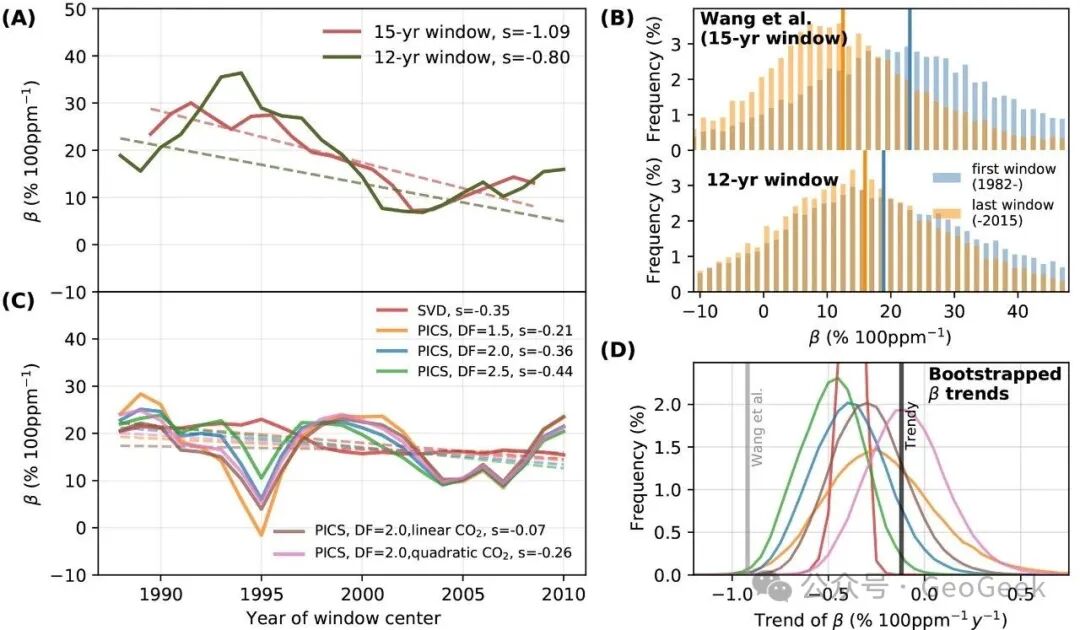
Figure 2 · The decline in β is sensitive to methodological choices. Changing the moving-window length, AVHRR correction, and treatment of CO₂ alters the estimated magnitude of decline; bootstrap estimates further widen the uncertainty. The original result is therefore sensitive to time-window choice, data correction, and statistical treatment (Frankenberg et al., 2021).
Sensor fusion
Zhu et al. moved the critique to cross-sensor harmonization. They questioned the direction of the AVHRR–MODIS adjustment used in the original analysis. If the newer MODIS observations are adjusted to match an older AVHRR series with larger uncertainty, uncertainty in the early product can be propagated across the combined record.
Under that situation, an apparent change in the later trend may not be entirely ecological. Part of it may be a consequence of the way the record was joined. This is a particularly serious problem for long-term analysis: if a different defensible stitching rule changes the trajectory, the conclusion is not only about how the Earth changed; it is also about how the data were made continuous.
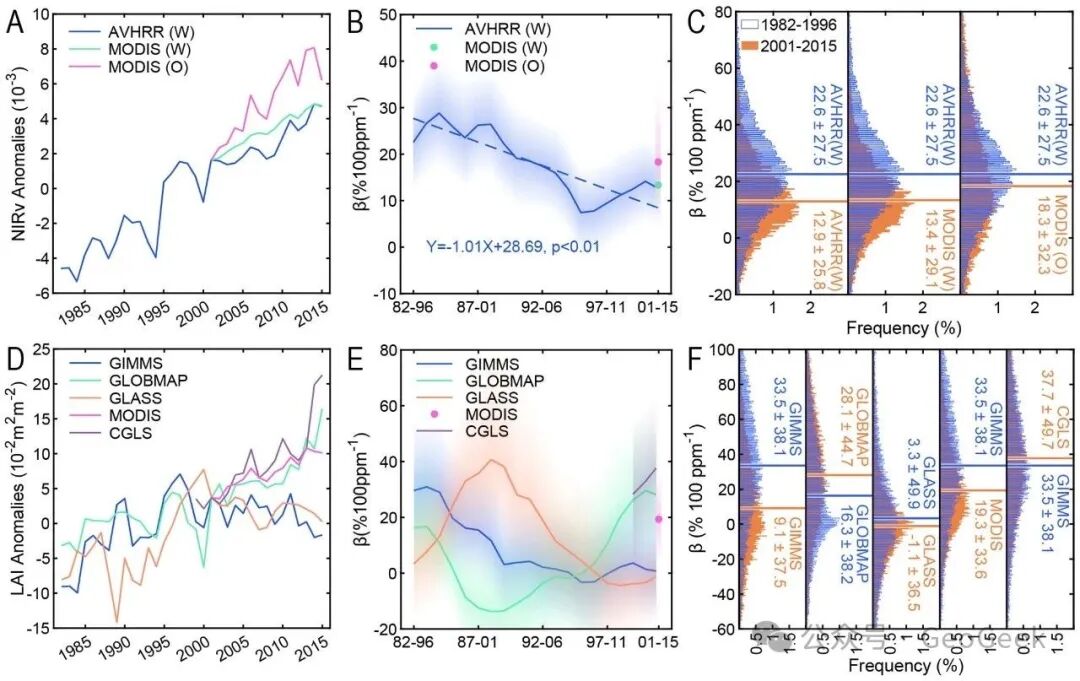
Figure 3 · Sensitivity of CFE estimates to data product and processing. Re-estimating β with different NIRv and LAI products produces non-identical temporal changes and period contrasts, showing that the inferred long-term CFE trajectory depends on product selection and data treatment (Zhu et al., 2021).
Attribution
Frankenberg and Zhu asked whether the long record was temporally comparable. Sang et al. challenged the interpretation of β itself. Even if the observations were harmonized as carefully as possible, they argued, β need not be a stable estimate of CFE. Photosynthesis responds not only to CO₂ but also to temperature, water availability, radiation, nutrient limitation, and other drivers. If those effects are not separated adequately, an apparent change in “CO₂ response” may contain changes in other controls.
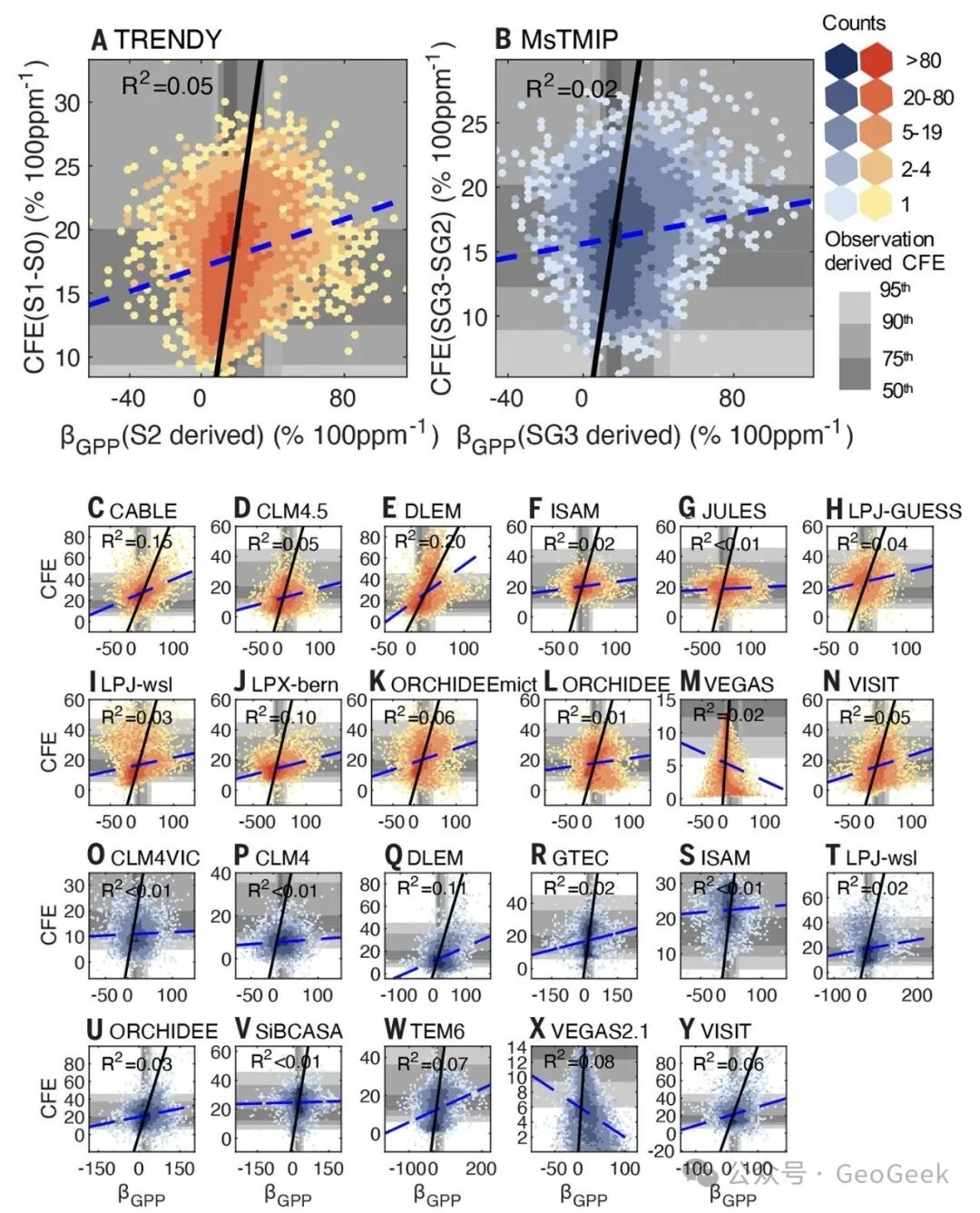
Figure 4 · Deviation between β and directly calculated CFE. Across several DGVMs, regression-derived β does not show a stable one-to-one relation with directly calculated CFE. Interpreting β as CFE can therefore introduce methodological bias (Sang et al., 2021).
03 · The response: robust direction, method-dependent magnitude
The original authors published a Response and carried out a substantial set of additional checks. They controlled for solar zenith angle, used alternative vegetation indices, tested CO₂ lag effects, removed pixels with high β, restricted analysis to intact forests, and introduced independent evidence with a different physical basis from the original satellite proxies.
Their central result was that alternative processing choices changed the magnitude of the decline but did not remove its direction. That matters: the finding was not tied to one single parameterization and did not disappear as soon as a reasonable setting was changed.
At the same time, the Response sharpened the methodological lesson. If a long-term conclusion needs to be tested repeatedly across different proxies, processing routes, and independent evidence before its direction can be considered stable, then the key question for long time series is no longer simply whether a result is significant under one specification. It is whether the result survives another defensible way of making the record temporally consistent.
For long-term remote sensing, robustness is therefore better expressed as stability across plausible correction paths than as significance under one processing path. When a paper says that some process has strengthened, weakened, or crossed a breakpoint over recent decades, the questions should include:
How sensitive is the result to sensor replacement? How sensitive is it to the way products are joined? How sensitive is it to model specification?
If those questions are left unresolved, a complete-looking trend can remain evidentially fragile.
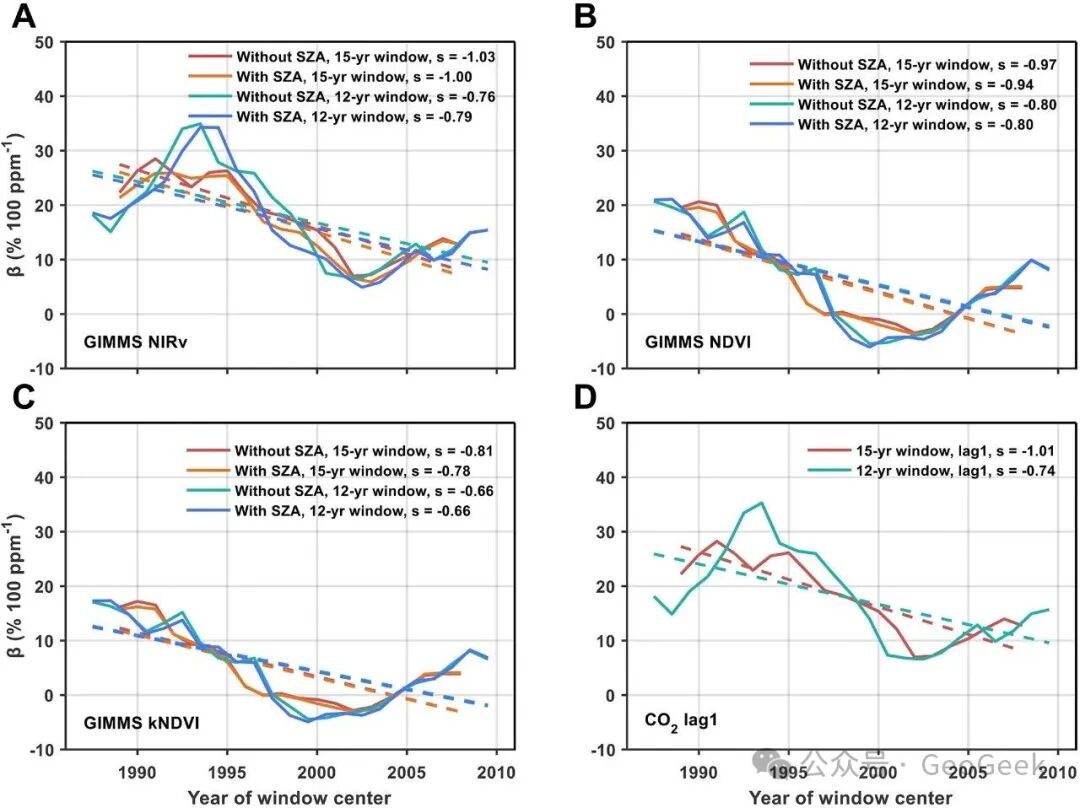
Figure 5 · Robustness of the β decline under alternative processing choices. GIMMS NIRv, NDVI, and kNDVI were used to compare treatments of AVHRR solar zenith angle, moving-window length, and CO₂ lag. β declines under multiple settings, but the magnitude and strength of the trend vary (Wang et al., 2021).
04 · What followed: from argument over a conclusion to correction of the record
After this debate, related work increasingly treated temporal consistency as a problem to be corrected explicitly: how can observations from different eras be placed on the same comparison basis?
In 2022, Wang et al. published a temporally corrected long-term SIF study. They noted that multisource long-term SIF products are affected by sensor degradation, so temporal correction should precede spatial downscaling and multisensor fusion. Using the Sahara as a reference target to calibrate sensor-specific temporal change, they constructed a temporally consistent SIF record for 1995–2018.
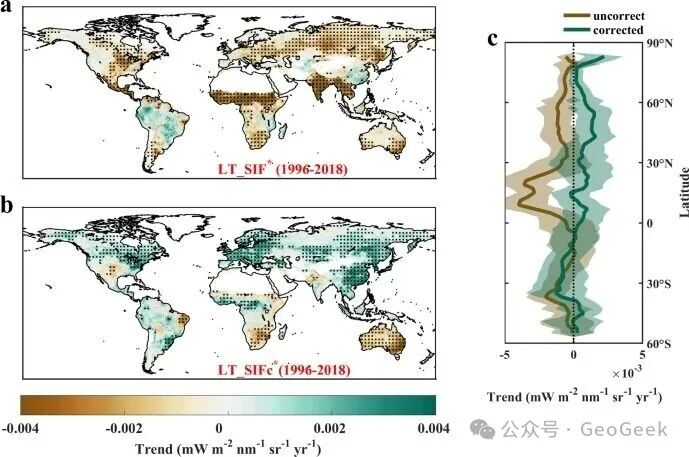
Figure 6 · Effect of temporal correction on global long-term SIF trends. Comparing trends before and after correction, and their zonal means, shows that temporal correction changes both spatial pattern and magnitude; in some regions even the sign of the trend changes (Wang et al., 2022).
In 2024, Jeong et al. addressed temporal inconsistency in AVHRR LTDR V5 by performing cross-calibration among AVHRR sensors, correcting orbital drift, and applying machine-learning harmonization with MODIS. Uncorrected data tended to suggest stronger greening before 2000 and weakening greening afterward. After the three-stage correction, global NDVI and NIRv instead indicated a more persistent four-decade greening trend. The authors emphasized that temporal inconsistency in long-term vegetation-index products can materially change conclusions about global trends.
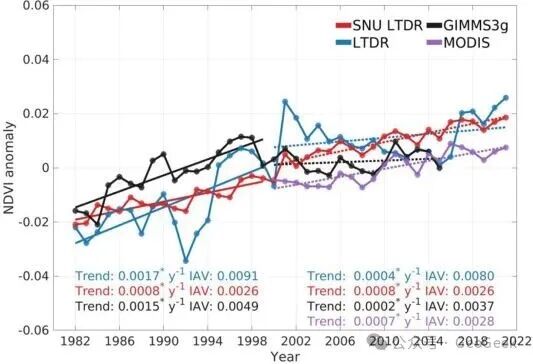
Figure 7 · NDVI time series before and after temporal-consistency correction. Growth-season anomalies from AVHRR LTDR, harmonized AVHRR, GIMMS3g, and MODIS are compared for 1982–1999 and 2000–2021. The uncorrected AVHRR record shows stronger phase differences, while the harmonized record agrees more closely with other datasets (Jeong et al., 2024).
By 2025, Fang et al., in a new Scientific Data product, treated removal of AVHRR orbital effects and cross-calibration with MODIS as prerequisite steps for constructing a continuous long-term reflectance and photosynthesis-proxy record, from which they reconstructed a global photosynthesis proxy for 1982–2023.
The important point is not whether any one later product should be treated as definitively superior to the records used by Wang et al. in 2020. It is that temporal consistency is increasingly recognized as a precondition of long-term remote-sensing inference rather than a secondary data-cleaning detail.
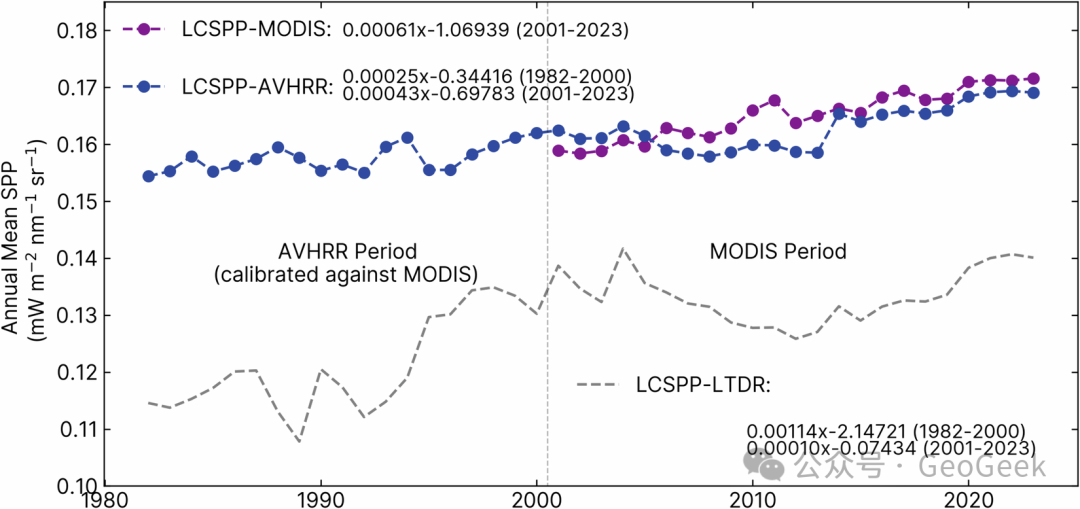
Figure 8 · Long-term photosynthesis-proxy reconstruction built on temporal-consistency correction. LCSPP time series reconstructed from AVHRR, MODIS, and the original LTDR product differ, showing that cross-sensor calibration and correction of orbital effects directly affect long-term trend estimates (Fang et al., 2025).
Closing note
As remote sensing becomes more capable of supporting multidecadal global narratives, one illusion becomes especially important to resist: that a longer record, a larger spatial extent, or a more prestigious journal automatically makes the conclusion more reliable.
For long-term remote sensing, duration does not automatically become evidential strength. A grand narrative cannot substitute for methodological comparability. If observations from different eras do not share a comparable measurement basis, a stable proxy relation, and a consistent inferential framework, then an apparently coherent long-term trajectory may be continuity produced by harmonization rather than continuity demonstrated in the Earth system.
Related notes: Nature versus Nature? The Problem Is Remote-Sensing Evidence; What Nature and Science Papers Reveal about Extrapolation Risk at Global Scale; Reassessing Global Tree-Restoration Potential after a Wave of Critiques.
References
- Wang, S. et al. Recent global decline of CO₂ fertilization effects on vegetation photosynthesis. Science, 370(6522), 1295–1300 (2020).
- Frankenberg, C., Yin, Y., Byrne, B., He, L., & Gentine, P. Comment on “Recent global decline of CO₂ fertilization effects on vegetation photosynthesis”. Science, 373(6562), eabg2947 (2021).
- Sang, Y., Huang, L., Wang, X., Keenan, T. F., Wang, C., & He, Y. Comment on “Recent global decline of CO₂ fertilization effects on vegetation photosynthesis”. Science, 373(6562), eabg4420 (2021).
- Zhu, Z. et al. Comment on “Recent global decline of CO₂ fertilization effects on vegetation photosynthesis”. Science, 373(6562), eabg5673 (2021).
- Wang, S. et al. Response to Comments on “Recent global decline of CO₂ fertilization effects on vegetation photosynthesis”. Science, 373(6562), eabg7484 (2021).
- Wang, S., Zhang, Y., Ju, W., Wu, M., Liu, L., He, W., & Peñuelas, J. Temporally corrected long-term satellite solar-induced fluorescence leads to improved estimation of global trends in vegetation photosynthesis during 1995–2018. ISPRS Journal of Photogrammetry and Remote Sensing, 194, 222–234 (2022).
- Jeong, S. et al. Persistent global greening over the last four decades using novel long-term vegetation index data with enhanced temporal consistency. Remote Sensing of Environment, 311, 114282 (2024).
- Fang, J., Lian, X., Ryu, Y., Jeong, S., Jiang, C. Y., & Gentine, P. A long-term reconstruction of a global photosynthesis proxy over 1982–2023. Scientific Data, 12(1), 372 (2025).