Reassessing Global Tree-Restoration Potential After a Wave of Critiques
The influential 2019 Science estimate of global restoration potential became a case study in how basemaps, validation, and extrapolation shape policy-scale numbers.
- Reference
- notes:n21
- Published
- 2026.03.27
- Series
- note
- Source
- Source ↗

In 2019, Bastin et al. published The global tree restoration potential in Science. The paper estimated that, without converting existing cropland or urban land, the world still had about 0.9 billion hectares of additional potential tree-canopy restoration area, with a theoretical capacity to store roughly 205 GtC.
The number moved rapidly from the scientific literature into public communication and policy debate. It became one of the most recognizable quantitative claims behind the idea that large-scale tree restoration could materially contribute to climate mitigation, and it strongly shaped how “global restoration potential” was imagined in policy discussions.
As the influence of the paper grew, so did scrutiny of its methods and interpretation. Subsequent challenges converged on three levels. First, did the current tree-cover baseline systematically underestimate existing trees in some regions? Second, was model accuracy inflated by an inappropriate validation design? Third, even after correcting those issues, can a global machine-learning map of this kind be evaluated well enough to support uniform confidence across the planet?
01 · The first wave: a cluster of Technical Comments
Soon after publication, the Science page accumulated a series of formal comments and author responses. In the second half of 2019 alone, at least five Technical Comments appeared, led by Veldman et al., Friedlingstein et al., Grainger et al., Lewis et al., and later Skidmore et al. The Bastin team published two formal responses, followed by an erratum in May 2020.
These comments did not all make the same criticism. Together, they decomposed the conditions under which the headline estimate could be interpreted.
Veldman et al. made one of the most direct challenges. They argued that the 205 GtC estimate was roughly five times too high. Their reasons included overstated gains in soil organic carbon, insufficient treatment of the warming effects associated with tree expansion at high latitudes and elevations, and the inclusion of tree planting in savannas, grasslands, and shrublands as “restoration.” The criticism exposed a fundamental conceptual issue: more trees are not automatically equivalent to ecological restoration.
Friedlingstein et al. moved the debate to the global carbon-cycle scale. They argued that interpreting 205 GtC as a major climate-mitigation potential was inconsistent with the dynamics of the global carbon cycle and its response to anthropogenic emissions.
Lewis et al. criticized several of the paper's most widely circulated statements, including the 205 GtC figure, the description of global tree restoration as the most effective available solution to climate change, and claims about future tropical forest loss.
Grainger et al. focused more on policy feasibility. They argued that the analysis neglected a substantial body of forest-mitigation work from the 1980s and 1990s and therefore failed to distinguish land that is biophysically capable of supporting trees from land that is actually available and operationally feasible for restoration.
Skidmore et al. focused on timescale. If the claimed carbon uptake were interpreted within more conventional carbon-accumulation horizons, they argued, the land area needed to achieve the same sequestration target would be at least three times larger.
In response, the Bastin team maintained that the original estimate represented the potential carbon stock of mature ecosystems under current climate, not the cumulative carbon that could be realized by a fixed date such as 2050. In the response to Skidmore, they also emphasized that the original paper did not impose a deadline by which restoration had to be completed.
At the same time, the authors acknowledged that some original wording lacked sufficient clarity and revised parts of the text in the subsequent erratum. By the end of this first debate, four issues had been isolated clearly: whether carbon uptake was overestimated, whether restoration had been conflated with afforestation, whether land feasibility had been simplified, and whether the timescale had been communicated too loosely.
02 · Fagan: the baseline map itself may be biased
If the Technical Comments first challenged interpretation and inference, Fagan's 2020 paper in Global Change Biology moved the critique further upstream: was the current tree-cover baseline itself systematically wrong?
Fagan argued that two influential global restoration-potential maps, including Bastin's, overestimated restoration potential in drylands because the underlying tree-cover products systematically under-detected sparse but real trees in open dryland ecosystems.
This is critical because Bastin's restoration potential is fundamentally a difference between potential tree cover and current tree cover. If current cover is biased low, the estimated restoration potential rises mechanically.
Fagan reported that in dryland biomes, the baseline products underestimated tree cover by about 5.9 percentage points on average. That bias could inflate Bastin's dryland restoration potential by roughly 315–440 million hectares, equivalent to 33%–45% of the estimated dryland restoration area. Even after accounting for Bastin's exclusion of cropland and urban areas, global restoration potential might still be overestimated by approximately 119–173 million hectares.
The argument was not that restoration is unimportant. It was that classifying large areas of naturally open, sparsely treed dryland as “empty land awaiting restoration” can both exaggerate carbon potential and misdirect restoration practice.
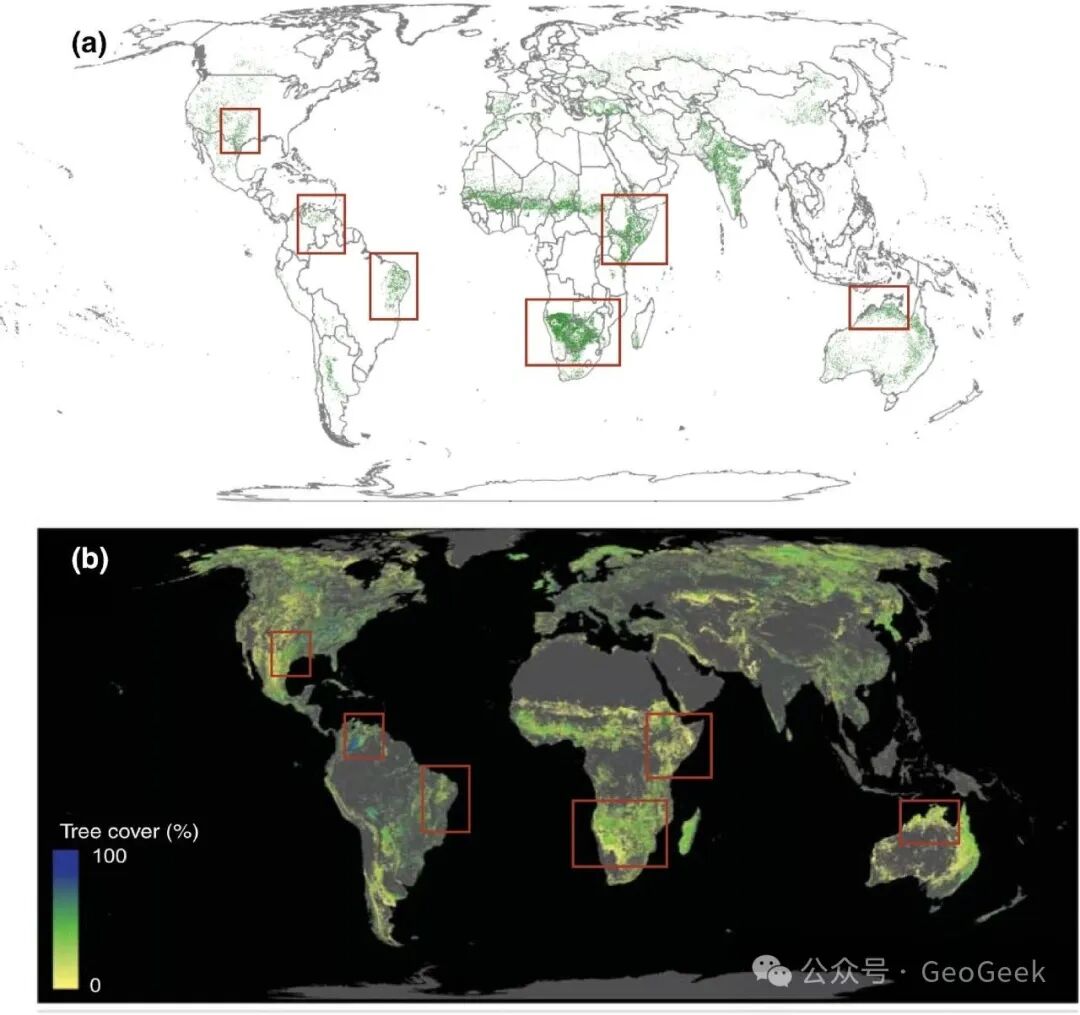
Figure 1 · Spatial overlap between mapped dryland restoration potential and underestimation of existing tree cover. Green sample points indicate locations where the Hansen Global Forest Cover product underestimates actual canopy cover; highlighted areas show that regions mapped as having high restoration potential often overlap places where the baseline tree-cover product is biased low. The overlap implies systematic inflation of restoration potential.
03 · Ploton: the illusion created by validation
Ploton et al. shifted attention to the evidence most often used to defend large-scale ecological machine-learning maps: model accuracy.
In a 2020 Nature Communications paper, the authors reconstructed a large-scale ecological mapping workflow using forest-inventory data covering roughly 11.8 million trees in Central Africa. Under conventional random cross-validation, the model appeared to explain more than half of the variance. Under spatial cross-validation designed to account for spatial autocorrelation, performance collapsed. A representative result was R² ≈ 0.53 under random K-fold validation and only ≈ 0.14 under spatial K-fold validation.
The implication was not that Bastin's restoration area had been directly recalculated. It was a broader methodological warning for global Random Forest maps of this kind: if training and test data are not spatially independent, a high R² cannot be interpreted as reliable prediction in new geographic regions.
The apparently strong fitting and cross-validation results in the Bastin study therefore need to be understood through a stricter spatial-validation lens.
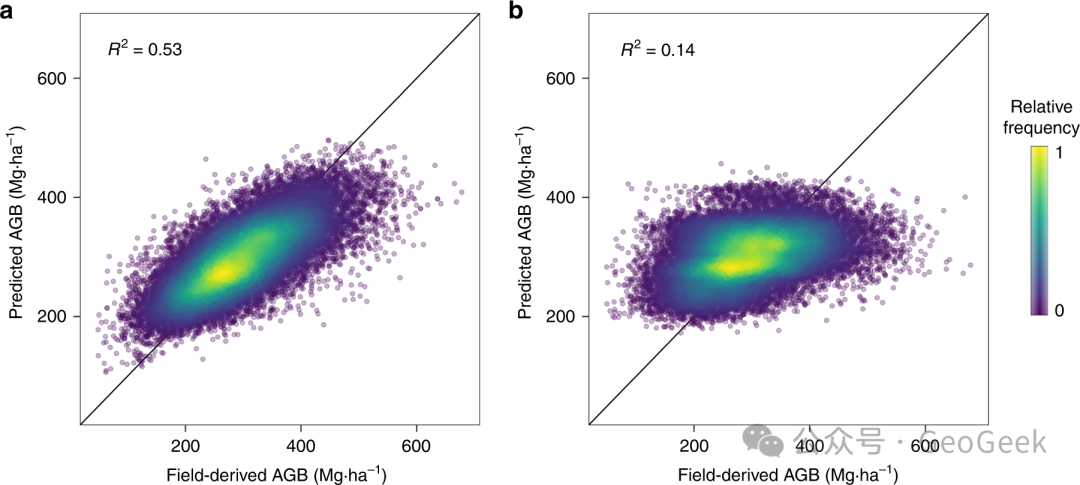
Figure 2 · Model performance under random and spatial cross-validation. Above-ground biomass predictions based on MODIS and environmental covariates look substantially stronger under random 10-fold validation than under spatial 44-fold validation. The comparison shows how conventional cross-validation can overestimate generalization when observations are spatially autocorrelated.
04 · Meyer and Pebesma: even better validation does not make every global pixel assessable
Meyer and Pebesma took the argument one step further in a 2022 commentary in Nature Communications. Their target was no longer Bastin alone, but the broader research paradigm of using machine learning to generate global maps of ecological variables.
Many global maps, they argued, are built from reference observations that are both sparse and geographically clustered rather than globally representative. Models are then applied far from the training observations and, in some regions, outside the environmental feature space represented in the training data. In those places, predictive quality may not be meaningfully assessable at all.
They therefore argued that a global ecological map should not imply that every pixel is equally trustworthy. It should identify the model's area of applicability: where predictions lie within the support of the training data, and where the model is effectively extrapolating.
This does not render the Bastin map worthless. It changes the category of claim that is defensible. The product is better read as an exploratory, upper-bound estimate than as a precision deployment map that can be translated directly into a policy checklist.
05 · How should the Bastin paper be read now?
The Bastin paper has not been simply “overturned.” But its most widely circulated number can no longer be read as a highly certain estimate of immediately realizable restoration area.
A more defensible description is: a macro-scale estimate of an upper bound on global tree-restoration potential under a particular set of assumptions.
The paper's scientific contribution remains important. It turned the question “how much additional tree cover could the world support?” into a quantitative, testable spatial problem and helped push restoration science toward higher-resolution global analysis.
What needed correction was not the proposition that restoration matters. It was the interpretation of certainty, applicability, and policy translatability.
The later debate supplies a more general rule for global mapping. Any map that appears complete, precise, and strongly actionable should be subjected to three separate checks: Are the inputs reliable? Is validation rigorous? Are the extrapolation boundaries explicit?
References
- Bastin, J.-F., Finegold, Y., Garcia, C., Mollicone, D., Rezende, M., Routh, D., Zohner, C. M., & Crowther, T. W. The global tree restoration potential. Science 365, 76–79 (2019). doi:10.1126/science.aax0848.
- Veldman, J. W. et al. Comment on “The global tree restoration potential”. Science 366, eaay7976 (2019).
- Friedlingstein, P., Allen, M., Canadell, J. G., Peters, G. P., & Seneviratne, S. I. Comment on “The global tree restoration potential”. Science 366, eaay8060 (2019).
- Grainger, A., Iverson, L. R., Marland, G., Prasad, A., & Ringius, L. Comment on “The global tree restoration potential”. Science 366 (2019).
- Lewis, S. L., Wheeler, C. E., Mitchard, E. T. A., & Koch, A. Comment on “The global tree restoration potential”. Science 366, eaaz0388 (2019).
- Skidmore, A. K., Wang, T., de Bie, C. A. J. M., Pilesjö, P., & Fatoyinbo, T. Comment on “The global tree restoration potential”. Science 366, eaax0848 (2019).
- Bastin, J.-F. et al. Response to Comments on “The global tree restoration potential”. Science 366, eaay8108 (2019).
- Bastin, J.-F. et al. Response to Comment on “The global tree restoration potential”. Science 366 (2019).
- Bastin, J.-F. et al. Erratum for the Report: “The global tree restoration potential”. Science 368, eabc8905 (2020).
- Fagan, M. E., Reid, J. L., Holland, M. B., Drew, J. G., & Zahawi, R. A. A lesson unlearned? Underestimating tree cover in dryland biomes biases global restoration maps. Global Change Biology 26, 4679–4690 (2020).
- Ploton, P. et al. Spatial validation reveals poor predictive performance of large-scale ecological mapping models. Nature Communications 11, 4540 (2020).
- Meyer, H. & Pebesma, E. Machine learning-based global maps of ecological variables and the challenge of assessing them. Nature Communications 13, 2012 (2022).