Writing Causal Claims Without Overreach
Causal language is earned by a question, a defensible causal structure, an identification strategy, and sensitivity analysis—not by significance alone.
- Reference
- notes:n06
- Published
- 2026.04.29
- Series
- note
- Source
- Source ↗
Ecology and environmental science are full of sentences that sound causal: rising temperature affects species mortality; floods alter bivalve abundance in estuaries; declining predator abundance causes prey populations to increase; human activity changes habitat use.
But what entitles us to write causes, affects, or changes on the basis of data?
A Perspective in Nature Communications, Best practices for moving from correlation to causation in ecological research, addresses this question systematically. Its central point is straightforward. “Correlation is not causation” is correct, but incomplete. “Only experiments can establish causation” is also too simple. A poorly designed experiment can support the wrong causal conclusion; a well-designed observational study can support a credible causal inference.
The decisive issue is not whether the data are observational. It is whether the study makes clear what causal question is being asked, what prior knowledge supports the proposed structure, which confounders may exist, which causal assumptions are being made, and whether the chosen method is compatible with those assumptions.
01 · Data do not supply a causal explanation by themselves
If X and Y are correlated, at least three broad explanations remain possible: X affects Y; Y affects X; or a third variable C affects both X and Y.
Ladybird abundance and earthworm abundance, for example, may covary. That does not mean one affects the other. Both may simply respond to pesticide use. Moving from association to causation therefore begins not with a more complicated model, but with the identification and treatment of common causes—confounders.
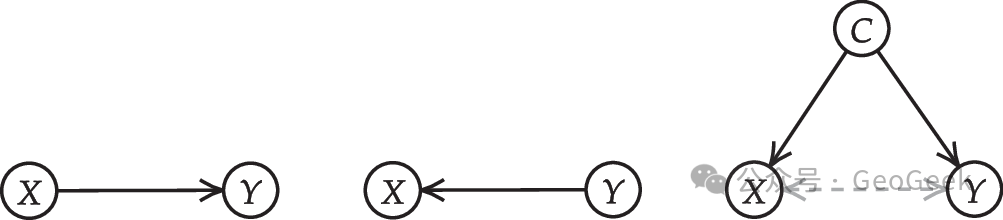
Figure 1 · Three causal structures can lie behind the same statistical association. X may cause Y, Y may cause X, or a common cause C may affect both. A first task in causal inference is to rule out or address confounding created by common causes (Correia et al., Nature Communications, 2026, Fig. 1).
02 · Three foundational assumptions
Causal sufficiency. A study must observe and include the common causes that jointly affect X and Y. In practical terms, the relevant confounders must not be omitted.
Causal Markov condition. If the association between X and Y is entirely generated by a common cause C, then X and Y should become conditionally independent once C is controlled.
Causal faithfulness. If two variables are statistically independent, that independence can be treated as evidence against the corresponding causal connection.
These assumptions generally cannot be established from the data alone. Causal inference is therefore not a procedure in which a model is asked to discover truth without commitments. It is an interpretation of data under explicit assumptions.
03 · A best-practice workflow for causal research
Step 1: define the causal question and summarize prior knowledge. Do not begin by asking whether a coefficient is significant. Begin by asking what causal question the study is actually intended to answer.
At minimum, the study should specify the outcome Y, the putative cause X, plausible confounders C, whether the cause temporally precedes the outcome, and whether mediation or reverse causation is possible.
The Perspective recommends two useful tools for organizing this prior knowledge. One is a causal directed acyclic graph, or causal DAG. The other is a target-trial thought experiment: imagine how an ideal randomized experiment would be designed if it were possible.
The purpose of a DAG is not to produce an attractive path diagram. It is to expose the researcher's causal commitments. Which arrows are assumed to exist? Which are assumed absent? Which variables are confounders? Which variables should be adjusted for—and which should not?
Step 2: distinguish causal discovery from causal inference. Ecological causal research contains at least two different tasks.
Causal discovery is appropriate when prior knowledge is limited. Its goal is to explore whether causal relations may exist among variables and what their direction might be. Examples include asking whether sardine and anchovy populations causally influence one another, or what causal network might connect prey, poaching, weather, and tiger activity. This is primarily exploratory and is useful for generating hypotheses, but its conclusions usually remain more uncertain.
Causal inference is appropriate when prior knowledge is stronger and the aim is to estimate the magnitude of a causal effect. How much would wildlife mortality change for a 1°C increase in temperature? How would a wildfire-suppression program alter tree-species composition? How much of the effect of flooding on bivalve abundance operates through salinity and nitrogen input? These questions require stronger commitments about causes, outcomes, confounders, and direction.
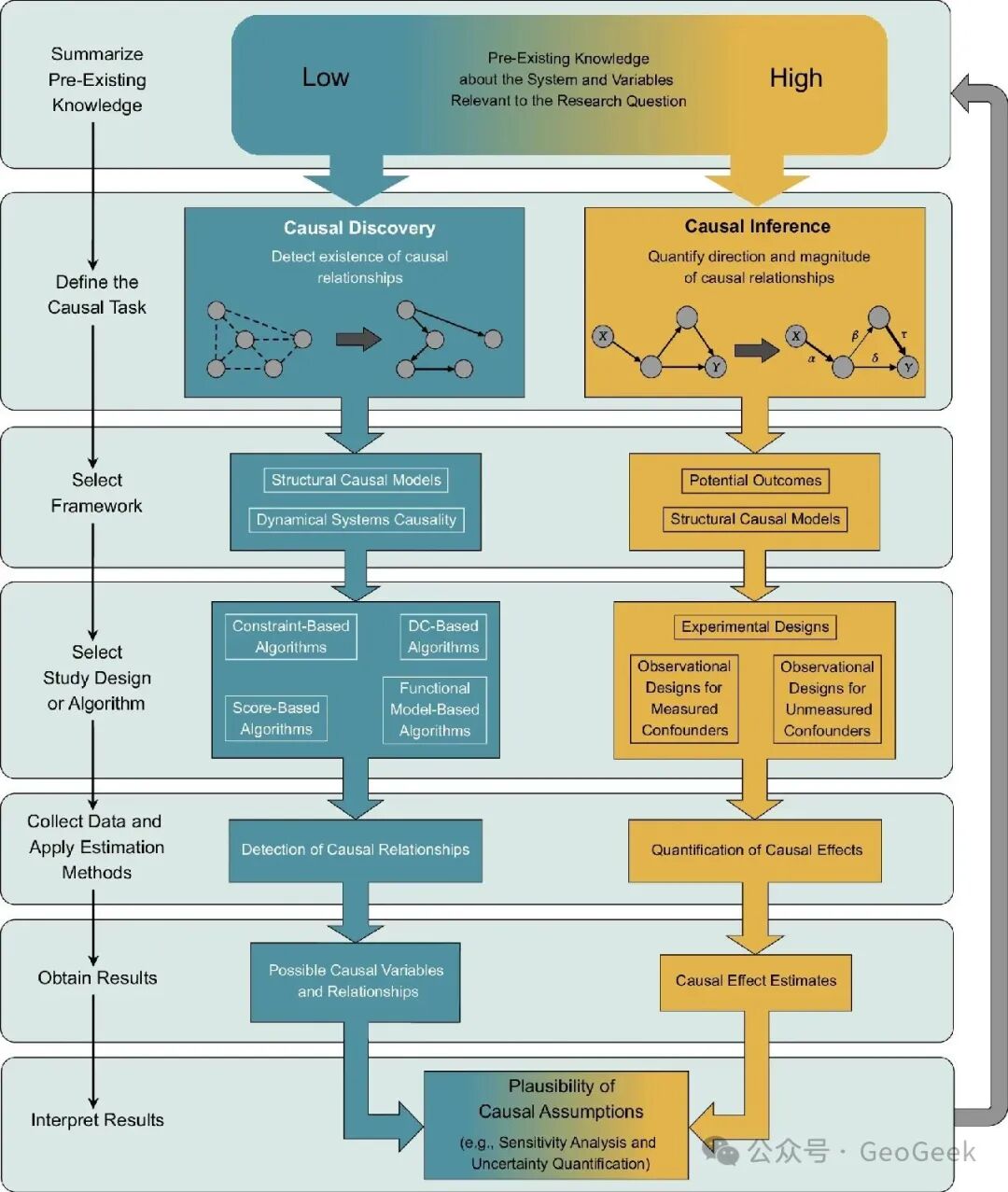
Figure 2 · A best-practice workflow for causal research in ecology. Define the causal question and the available knowledge first; distinguish causal discovery from causal inference; then choose a causal framework, study design, or algorithm; finally, use sensitivity analysis to test how strongly the conclusions depend on key assumptions (Correia et al., Nature Communications, 2026, Fig. 3).
Step 3: choose a causal framework. The Perspective discusses several common frameworks.
The Potential Outcomes, or Neyman–Rubin, framework asks a counterfactual question: for the same unit, how would the outcome differ under treatment versus no treatment?
A Structural Causal Model (SCM) expresses structural relations among multiple variables through causal graphs. Structural equation models that are interpreted causally likewise require assumptions of this kind.
Dynamical-systems causality is more suited to time series and dynamic ecological systems—for example, asking whether the past state of one variable improves prediction of another variable's future trajectory in a way consistent with causal coupling.
Step 4: choose the study design or algorithm, then test robustness. For causal inference, the article distinguishes three broad classes of design: experiments, which manipulate the putative cause and use randomization to reduce confounding; observational designs that adjust for measured confounders, including regression adjustment, propensity-score matching, and structural equation approaches; and observational designs intended to address unmeasured confounding by using external variation or additional structural assumptions.
For causal discovery, the article discusses constraint-based methods, score-based methods, functional-model approaches, and dynamical-systems methods such as convergent cross mapping.
Whichever route is chosen, the article insists on one point: an estimated effect or a causal-network diagram is not the end of the analysis. Sensitivity analysis is needed to show how conclusions would change if important causal assumptions were violated.
04 · The center of causal research is the assumption, not the model
No amount of model complexity automatically converts association into causation. Machine learning, SEM, CCM, DAGs, propensity scores, and random forests are not causal talismans.
If a study cannot explain why variation in X can be regarded as exogenous, why important confounders have been addressed, why reverse causation is not a major alternative, why temporal ordering is plausible, or why unmeasured confounding is unlikely to overturn the result, then the word causal has arrived too early.
Causal language in ecology and geoscience can therefore be calibrated to the evidence. If a study only observes covariation between X and Y, write associated with, correlated with, or changes alongside. If there is a clear mechanistic hypothesis and a defensible confounding strategy, stronger but still qualified language may be appropriate: the results are consistent with a causal interpretation or support the hypothesis that X affects Y. If the design satisfies, or credibly substitutes for, the assumptions required for identification and the result survives sensitivity analysis, then it becomes more defensible to write that X has a causal effect on Y. Where an explicit counterfactual framework is available, the analysis can go further and ask whether Y would have differed in the absence of X.
This hierarchy also corresponds to Pearl's causal ladder discussed in an earlier note: association, intervention, and counterfactual questions are different questions, and they warrant different forms of causal language.
Closing note
The paper offers a useful discipline for scientific writing. Moving from correlation to causation is not a progression from simple models to complicated ones. It is a progression from vague questions to explicit questions, from hidden assumptions to stated assumptions, and from reporting significance to reporting identification conditions and robustness.
A strong causal paper does not merely ask, “Are X and Y significantly associated?” It asks: under what causal question, on the basis of what prior knowledge, under which untestable but defensible assumptions, and using what design or algorithm are we entitled to interpret this relation causally?
The original Perspective is worth reading in full: doi:10.1038/s41467-026-69878-z.
Reference
- Correia, H. E. et al. Best practices for moving from correlation to causation in ecological research. Nature Communications 17, 1981 (2026).