Greener Is Not Necessarily More Productive
Greenness, vegetation cover, and productivity often move together—but global evidence shows that they diverge across large parts of the vegetated world.
- Reference
- notes:n07
- Published
- 2026.04.27
- Series
- note
- Source
- Source ↗
In terrestrial ecology, remote-sensing indices such as NDVI, EVI, and LAI capture aspects of spectral reflectance, light absorption, and canopy structure. They are therefore routinely used to describe vegetation greenness, canopy structure, and activity. Some are then carried one step further and used to estimate photosynthesis or productivity. Researchers consequently use them to discuss productivity, GPP, carbon uptake, and even ecosystem functioning.
There is a proxy chain hidden in that practice. A satellite records radiometric signal X. Index construction or retrieval produces NDVI, EVI, LAI, NIRv, or another remotely sensed variable R. R is then used to interpret an ecological object O—productivity, GPP, carbon uptake, or ecosystem functioning. The methodological question is therefore not only whether X→R is accurate. It is whether R→O is valid. Even if NDVI, EVI, or LAI is measured reliably, its ability to represent productivity or GPP under a particular ecological context still has to be tested.
01 · Greenness, cover, and productivity do not always move together
If greenness, cover, and productivity were simply three interchangeable expressions of one vegetation-growth signal, global vegetation change should show a broadly coherent pattern: greener vegetation, greater cover, and higher productivity should tend to occur together. Ding et al. tested that premise by comparing global trends in vegetation greenness, cover, and productivity between 2000 and 2015. They did not treat “vegetation growth” as a single quantity. Instead, they separated three dimensions that are often conflated despite carrying different ecological meanings.
The result was striking: 45.6% of the world's vegetated area showed inconsistent changes among greenness, cover, and productivity. Across nearly half of the global vegetated land surface, becoming greener, increasing cover, and becoming more productive did not occur in step (Ding et al., Earth's Future, 2020). Greenness change therefore cannot be assumed to summarize productivity change. A greener surface is not necessarily a more productive one.
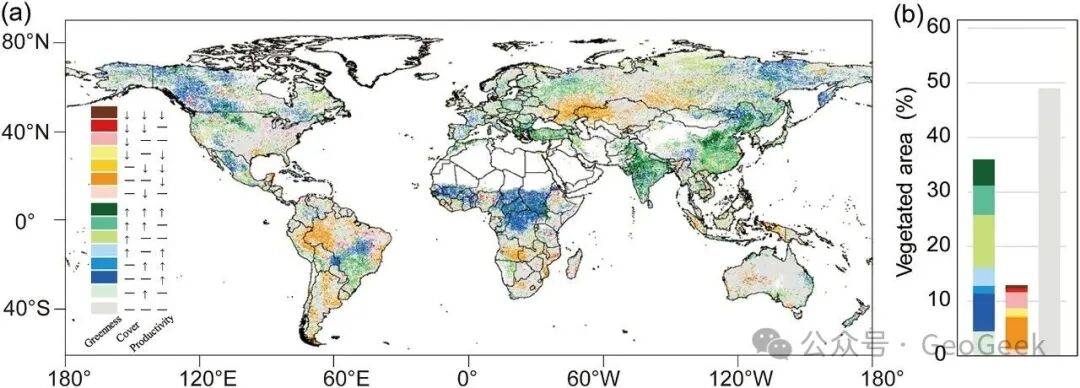
Figure 1 · Spatial distribution and area fractions of combined trends in vegetation greenness, cover, and productivity. Global vegetation change during 2000–2015 did not take the form of a single coherent increase or decrease. Large areas showed divergence among the three dimensions; 45.6% of vegetated land exhibited inconsistent changes. A single greenness metric is therefore not a robust universal summary of productivity or ecosystem functioning (Ding et al., Earth's Future, 2020, Fig. 3).
02 · Decoupling is structured by ecological context
Hu et al. examined the global spatial pattern of the interannual relationship between LAI and GPP using long remote-sensing records, flux-tower GPP, and multiple land-surface models. They found that the LAI–GPP relationship changes systematically along the aridity gradient. In dry grasslands, interannual GPP and LAI are tightly coupled. In humid evergreen broadleaf forests, the relation weakens markedly and may become decoupled (Hu et al., Remote Sensing of Environment, 2022).
The reason is ecological rather than statistical noise. In water-limited grasslands, structural vegetation change often tracks productivity because water limitation constrains both. LAI can therefore represent interannual GPP variation reasonably well. In humid evergreen broadleaf forest, canopies are often already closed and interannual LAI variation is relatively small, while GPP can vary with leaf physiology, photosynthetic efficiency, radiation, and environmental stress. Stable or increasing LAI cannot therefore be interpreted everywhere as stable or increasing GPP.
The LAI→GPP relation is a conditional proxy relation constrained by aridity, biome type, canopy structure, and leaf physiology. Outside those conditions, treating LAI or greenness as a stable proxy for productivity turns a conditional representation into a universal one.
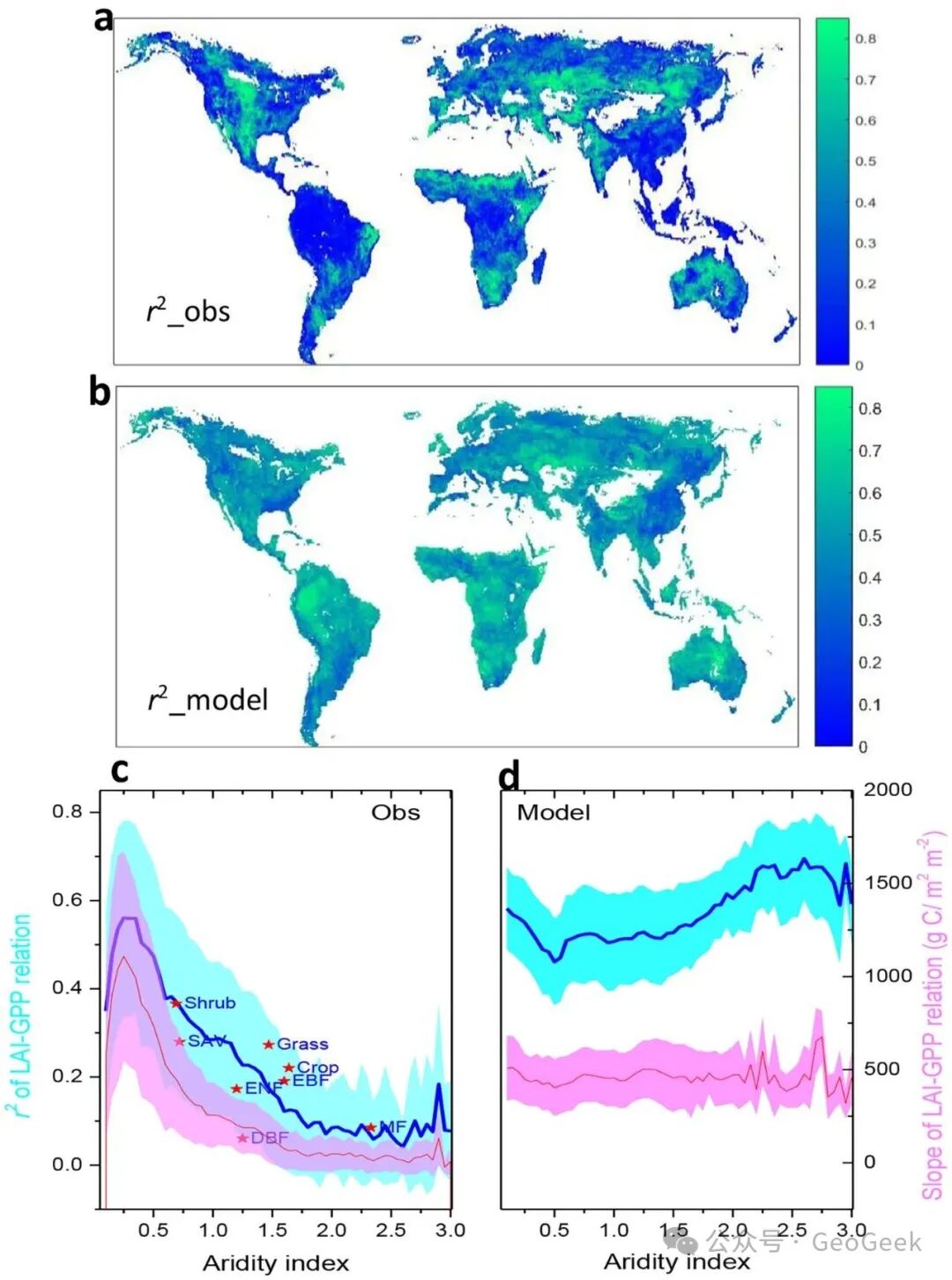
Figure 2 · Global distribution of interannual LAI–GPP coupling and its variation along the aridity gradient. Observation-constrained results show that LAI represents GPP more strongly in dry regions and much less strongly in humid forests. The relation has a clear environmental dependence rather than random spatial variability (Hu et al., Remote Sensing of Environment, 2022, Fig. 2).
Closing note
Satellites can observe signals associated with vegetation greenness, canopy structure, and light absorption with considerable precision. They do not automatically observe whether an ecosystem has become more productive or is taking up more carbon. Greenness is not productivity. LAI is not GPP. NDVI, EVI, and NIRv are not ecosystem functioning.
“More productive” is therefore not, by itself, a satellite-observed fact. It is an inference built from remote-sensing inputs, ecological assumptions, and model structure. The distinction matters: satellite-derived is not the same as satellite-observed.
Nor is the mapping from greenness or LAI to productivity or GPP a stable relation that can be inherited without qualification. It is conditional on aridity, biome, canopy structure, and leaf physiology. This is the terrestrial version of the Proxy-of-a-Proxy problem: remote-sensing research must do more than show that it has estimated R accurately. It must also show that, under the conditions of the study, R is a defensible representation of O. Otherwise, greener does not necessarily mean more productive.
References
- Ding, Z., Peng, J., Qiu, S., Zhao, Y. Nearly Half of Global Vegetated Area Experienced Inconsistent Vegetation Growth in Terms of Greenness, Cover, and Productivity. Earth's Future, 8, e2020EF001618 (2020).
- Hu, J., Piao, S., Knapp, A. K., Wang, X., Peng, S., Yuan, W., Running, S., Mao, J., Shi, X., Ciais, P., et al. Decoupling of greenness and gross primary productivity as aridity decreases. Remote Sensing of Environment, 279, 113120 (2022).