Chl-a Is Not Biomass: When the Proxy Reverses
Chlorophyll-a and phytoplankton biomass can decouple, vary for different physiological reasons, and in some regions even move in opposite directions.
- Reference
- notes:n08
- Published
- 2026.04.25
- Series
- note
- Source
- Source ↗
In ocean research, chlorophyll-a concentration (Chl-a) has long been used as a proxy for phytoplankton biomass. The reason is understandable: chlorophyll is one of the most accessible bio-optical properties of phytoplankton, and in many settings it is assumed to vary with biomass. The difficulty is that this relation is not stable. Chl-a and biomass are linked through a conditional proxy relation shaped by physiology, light environment, nutrient regime, temperature, and ecological region.
01 · Chl-a and biomass can decouple
Behrenfeld et al. (2005) is one of the landmark studies in the development of carbon-based satellite estimates of ocean productivity. In building that framework, the authors showed systematically that Chl-a and phytoplankton biomass do not always vary together. A central limitation of conventional ocean NPP algorithms, they argued, is the treatment of chlorophyll as an index of phytoplankton biomass without adequately accounting for physiological changes in cellular pigmentation in response to light, nutrients, and temperature.
The regional seasonal evidence is especially important. Across many low-productivity ocean regions, phytoplankton biomass can remain comparatively stable through the year while Chl-a shows a pronounced seasonal cycle. Much of that chlorophyll variability is driven by physiological acclimation to changing environmental conditions rather than by an equivalent change in biomass. Behrenfeld et al. therefore made a deliberately strong statement: chlorophyll concentration is a poor proxy of phytoplankton biomass within large areas of the ocean. In such regions, Chl-a contains a substantial physiological signal and can become genuinely decoupled from biomass.
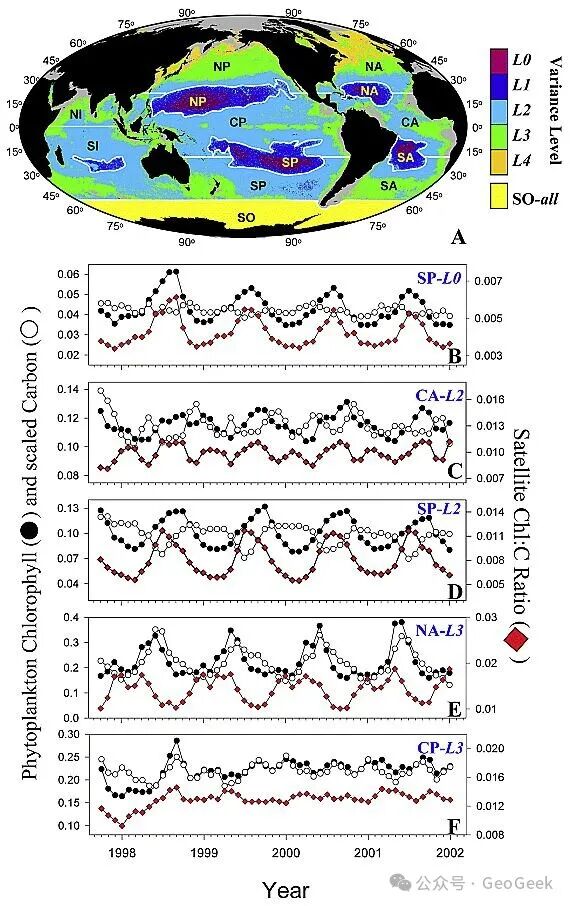
Figure 1 · Regional divisions and seasonal patterns of phytoplankton chlorophyll (Chl-a) and biomass. The study divided the ocean into 28 regions by basin and chlorophyll variability; representative seasonal trajectories show that in several low-productivity regions, chlorophyll varies much more strongly than biomass. The divergence indicates that changes in Chl-a can primarily reflect physiological responses to light, nutrient, and temperature conditions rather than biomass accumulation or loss (Behrenfeld et al., Global Biogeochemical Cycles, 2005, Fig. 2).
02 · The decoupling is structured, not exceptional
Is this merely a local or occasional problem? Work by Siegel et al. suggests otherwise. They decomposed satellite-derived chlorophyll variability into a biomass component and a physiological component. In the operational framework of that study, physiology was represented largely by light-driven photoacclimation—the adjustment of cellular chlorophyll content as phytoplankton respond to changes in the light environment.
The spatial pattern was systematic. At high latitudes and in persistent or seasonal upwelling regions, chlorophyll variability was often dominated by changes in biomass, so Chl-a remained a comparatively useful biomass proxy. Across broad tropical and subtropical waters, however, much of the observed Chl-a variability was driven not by biomass accumulation but by physiological adjustment to light (Siegel et al., Remote Sensing of Environment, 2013).
In some physiology-dominated regions, regression coefficients representing the biomass contribution were even negative, implying an inverse relationship between observed Chl-a and biomass. The Chl-a→biomass relation is therefore not merely noisy. Its mechanism can change across ecological regimes, and in some settings its direction can reverse. A proxy whose meaning shifts by region cannot defensibly be treated as universally stable.
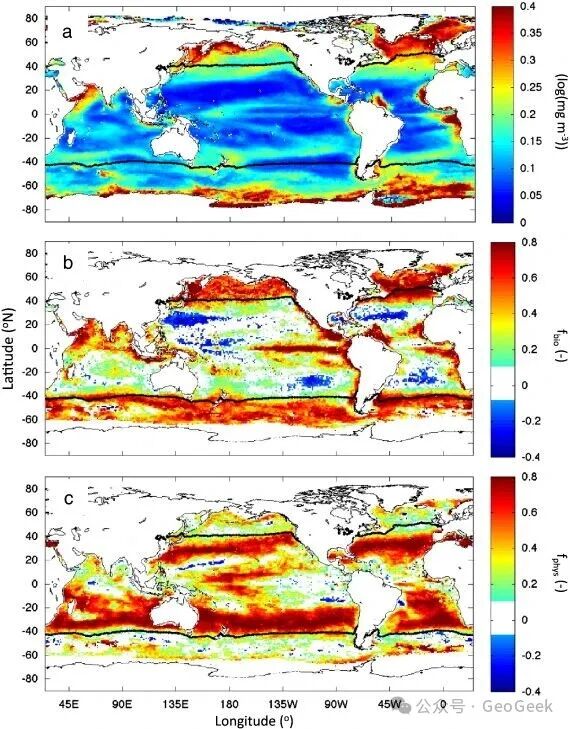
Figure 2 · Global distribution of the biomass contribution and physiological contribution to Chl-a variability. High-latitude and upwelling regions are more strongly biomass-driven; broad tropical and subtropical regions are often dominated by physiological adjustment, especially photoacclimation. The map makes the regional boundary conditions of Chl-a as a biomass proxy explicit (Siegel et al., Remote Sensing of Environment, 2013, Fig. 8).
If Siegel et al. demonstrated the spatial instability of the Chl-a→biomass relation, later work by Behrenfeld and colleagues showed that the same instability matters for temporal anomalies. In global-change studies, Chl-a anomalies are often negatively correlated with sea-surface temperature anomalies: warmer surface water is associated with lower chlorophyll. It is tempting to interpret this as warming reducing phytoplankton biomass, followed by lower productivity. The inference is not secure, because Chl-a anomalies contain both biomass and physiological signals.
Warming alters stratification, mixed-layer depth, and the light environment. Phytoplankton can respond through photoacclimation, changing cellular pigmentation and therefore the carbon-to-chlorophyll ratio, θ. A fall in Chl-a may therefore reflect less chlorophyll per unit biomass rather than a proportional decline in biomass itself (Behrenfeld et al., Nature Climate Change, 2016).
The global estimates make the point quantitative. Using more than a decade of MODIS Aqua observations, the authors found that across more than 75% of the ocean, most interannual Chl-a anomalies could be attributed to physiological variation in θ rather than to biomass change; across roughly 40% of the ocean, changes in θ explained more than 85% of Chl-a anomalies. In large parts of the global ocean, therefore, a Chl-a anomaly is first and foremost a physiological signal, not a direct biomass signal.
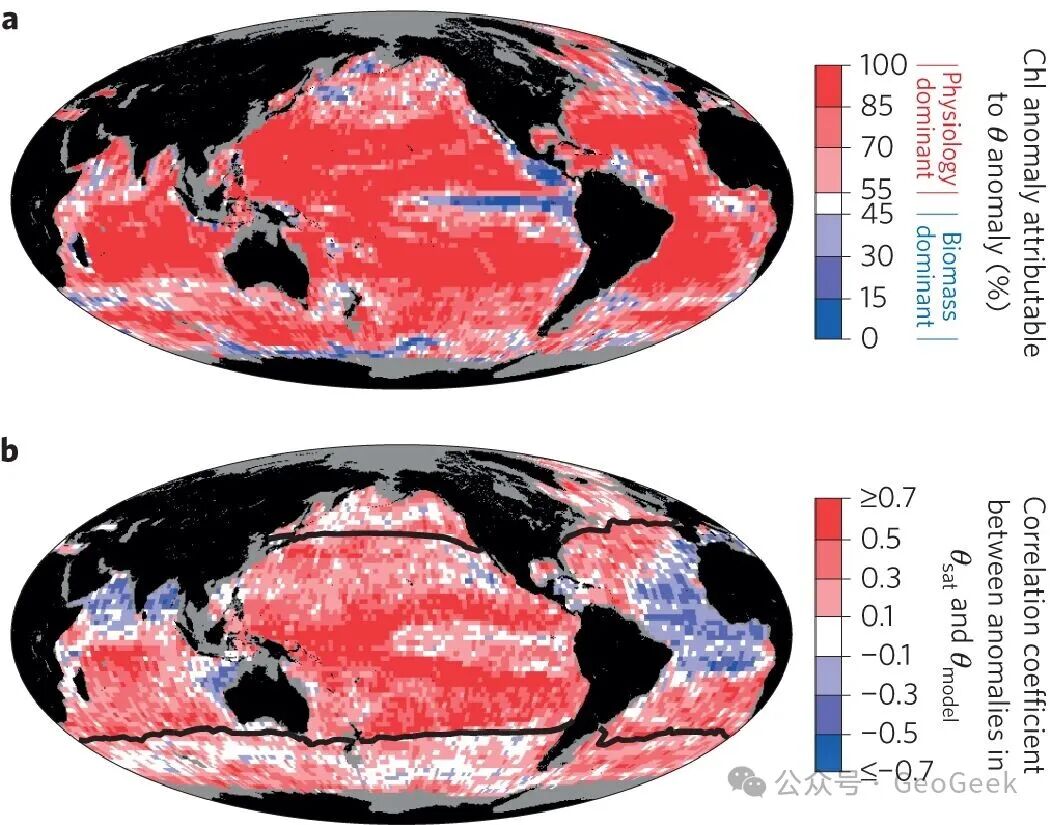
Figure 3 · Global fraction of interannual Chl-a anomalies explained by physiological variation in θ, the phytoplankton carbon-to-chlorophyll ratio. The accompanying comparison between observed and photoacclimation-modelled θ anomalies shows that light-driven photoacclimation is an important source of this variability (Behrenfeld et al., Nature Climate Change, 2016, Fig. 5).
03 · How large can the resulting bias be?
Graff et al. provide a particularly direct empirical answer. Whereas Behrenfeld et al. (2005) and Siegel et al. (2013) largely worked through optical proxy pathways, Graff and colleagues used sorting flow cytometry combined with elemental analysis to obtain a more direct empirical measure of phytoplankton carbon biomass. They then compared those biomass measurements with Chl-a. The second proxy relation—Chl-a→biomass—could therefore be tested directly rather than inferred indirectly.
The biomass:Chl-a ratio varied by an order of magnitude across ecosystems. Direct field measurements ranged from 31 to 358, while optically derived values along the AMT-22 transect ranged from 35 to 408. For this dataset, applying a single phytoplankton-carbon conversion factor to Chl-a would produce over- or underestimates of biomass by as much as a factor of three across a substantial fraction of the ocean. In cross-ecosystem comparisons, the proxy relation is therefore not merely approximate; it can generate large and systematic error.
Graff et al. also found that Chl-a explained directly measured biomass with R² = 0.52, weaker than the relation between particulate backscattering, bbp, and biomass, for which R² = 0.69. Their conclusion was explicit: Chl-a is not the best estimator of biomass. The issue is not only that physiology occasionally perturbs the Chl-a signal. Empirically, Chl-a is not a stable or uniformly preferred estimator of phytoplankton biomass.
It is better understood as a conditional proxy whose validity depends strongly on physiology, environmental regime, and ecosystem context. Under particular regional and mechanistic conditions, Chl-a may approximate biomass well. Outside those conditions, treating it as a universal biomass proxy lacks a sufficient methodological basis.
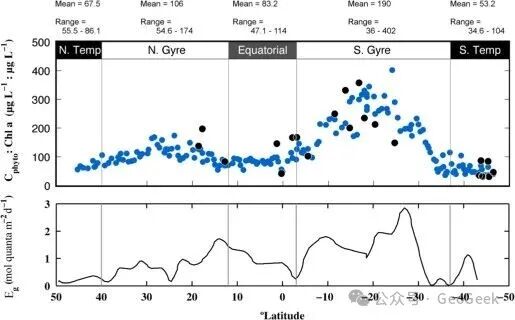
Figure 4 · Variation in the biomass:Chl-a ratio along the AMT-22 transect. The ratio spans roughly an order of magnitude, showing that there is no stable single conversion between chlorophyll and directly measured phytoplankton biomass. A uniform conversion factor would therefore generate substantial systematic error (Graff et al., Deep-Sea Research I, 2015, Fig. 6).
Closing note: the second proxy still has to be validated
Remote-sensing knowledge of an environmental object O is not normally obtained through direct observation. The observed signal X is passed through a retrieval operator F to produce an estimate R of a reference variable M; M is then used, under a representation relation P and a set of conditions C, to interpret O. A conclusion about O is justified only when both layers hold: R≈M, and M→O under C. For the broader framework, see What Remote Sensing Sees—and What It Does Not: The Proxy-of-a-Proxy Problem.
Remote-sensing studies devote considerable effort to the first layer. Accuracy, bias, RMSE, and R² primarily evaluate whether the retrieval R approximates M. But accurate retrieval of M does not by itself establish knowledge of O. The often-neglected second layer is whether M remains a stable representation of O under the conditions of the study.
If that relation is condition-sensitive, unstable, or subject to mechanism switches across ecological regions, conclusions about O can remain fragile even when the retrieval is excellent. In the present case, the central question is not whether Chl-a can be retrieved accurately. It is whether accurately retrieved Chl-a can still be treated as a stable proxy for phytoplankton biomass. That is the point of the Proxy-of-a-Proxy framework: it is not enough to show that remote sensing has “measured M correctly.” One must also show that M, under C, genuinely represents O.
References
- Behrenfeld, M. J., Boss, E., Siegel, D. A., Shea, D. M. Carbon-Based Ocean Productivity and Phytoplankton Physiology from Space. Global Biogeochemical Cycles, 19, GB1006 (2005).
- Siegel, D. A., Behrenfeld, M. J., Maritorena, S., McClain, C. R., Antoine, D., Bailey, S. W., Bontempi, P. S., Boss, E. S., Dierssen, H. M., Doney, S. C., et al. Regional to global assessments of phytoplankton dynamics from the SeaWiFS mission. Remote Sensing of Environment, 135, 77–91 (2013).
- Graff, J. R., Westberry, T. K., Milligan, A. J., Brown, M. B., Dall'Olmo, G., van Dongen-Vogels, V., Reifel, K. M., Behrenfeld, M. J. Analytical phytoplankton carbon measurements spanning diverse ecosystems. Deep-Sea Research Part I: Oceanographic Research Papers, 102, 16–25 (2015).
- Behrenfeld, M. J., O'Malley, R. T., Boss, E. S., Westberry, T. K., Graff, J. R., Halsey, K. H., Milligan, A. J., Siegel, D. A., Brown, M. B. Revaluating ocean warming impacts on global phytoplankton. Nature Climate Change, 6, 323–330 (2016).