What Remote Sensing Sees—and What It Does Not: The Proxy-of-a-Proxy Problem
High retrieval accuracy does not guarantee a valid environmental conclusion. Remote sensing often estimates a measurable variable first and interprets the target object only through a second proxy relation.
- Reference
- notes:n10
- Published
- 2026.04.23
- Series
- note
- Source
- Source ↗
A remote-sensing retrieval can achieve an R² of 0.90 and the paper's environmental conclusion can still be wrong. This is a common but rarely stated problem in applied remote sensing: the Proxy-of-a-Proxy problem.
01 · What is a Proxy of a Proxy?
Applied remote sensing usually cannot observe the environmental object that ultimately matters to the study. A sensor first records electromagnetic signals. A retrieval model then estimates a measurable variable from those observations. Researchers subsequently use that variable to discuss a higher-level environmental object, ecological state, or process.
In an earlier note, Remote Sensing Retrieves Chl-a, but the Paper Discusses Phytoplankton Biomass, I described this as a two-layer proxy chain: first a reference-variable retrieval, then an environmental interpretation.
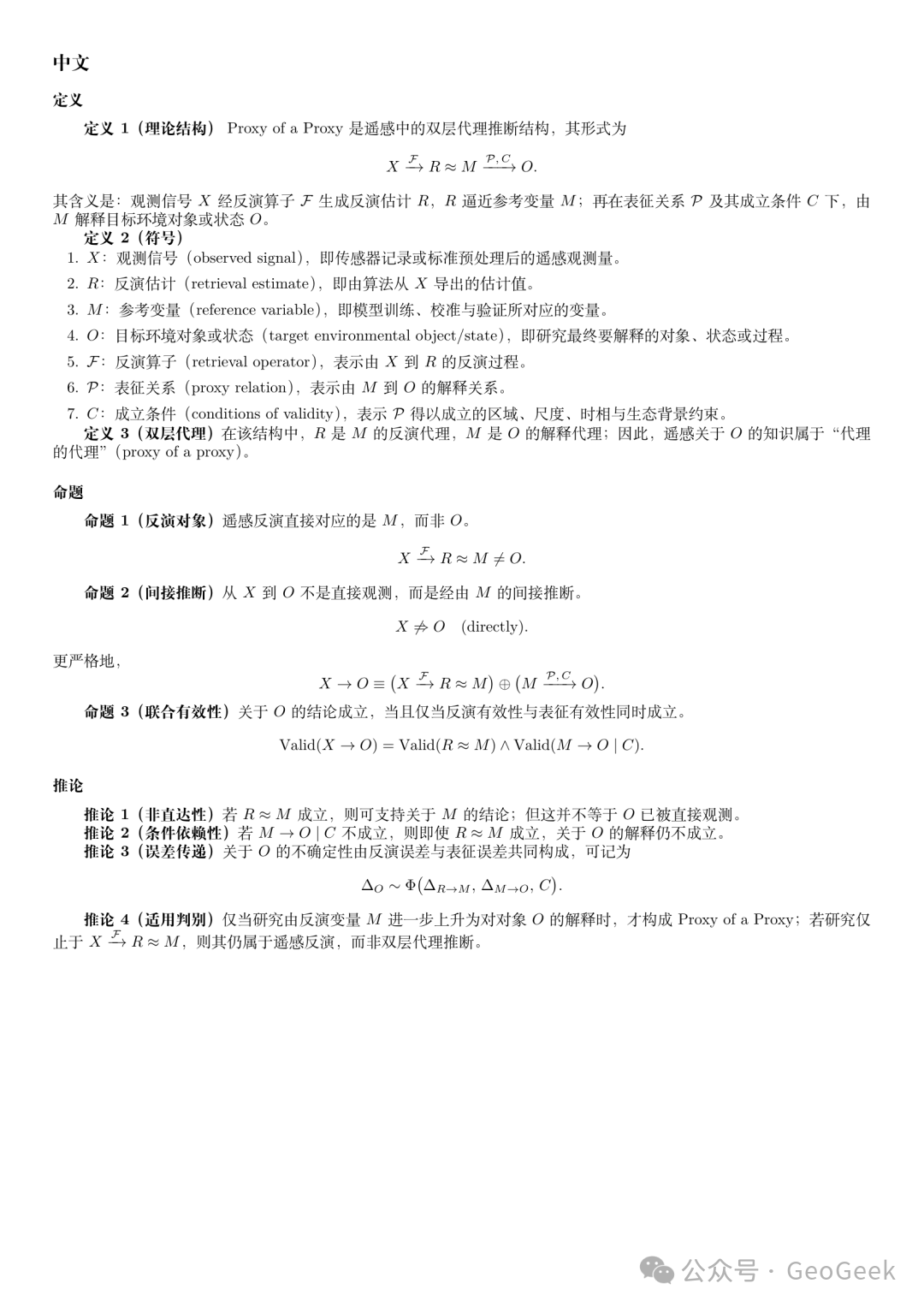
The chain can be written as:
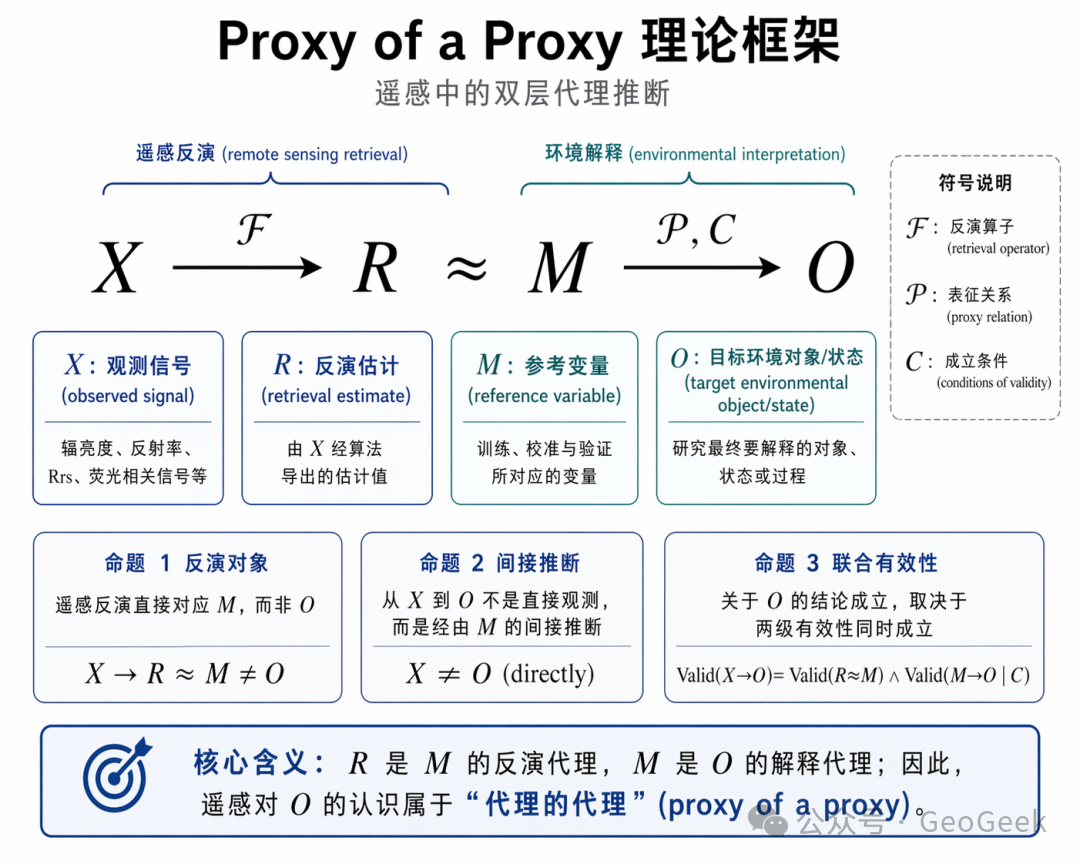
X → R ≈ M → O
Here, “≈” means that R is intended to be a reliable estimate of M, while “→” denotes an inferential step.
The framework contains two stages. In the remote-sensing retrieval, observed signal X is passed through a retrieval operator F to produce R, an estimate of reference variable M (R≈M). In the environmental interpretation, M is used to infer an environmental object or state O under a known representation relation P and the conditions C under which that relation is expected to hold (M→O | C).
R is therefore a proxy for M, and M is itself a proxy for O. Remote-sensing knowledge of O is consequently a two-layer proxy knowledge mediated by a reference variable.
The framework leads to three propositions.
1. Retrieval target. A remote-sensing retrieval directly corresponds to M, not O.
2. Indirect inference. The path from X to O is not direct observation. It is an inference mediated by M.
3. Joint validity. A conclusion about O requires two valid links at once: R must reliably approximate M (R≈M), and under conditions C, M must reasonably represent or support inference about O (M→O | C).
02 · What remote sensing sees: retrieval accuracy
Most validation in applied remote sensing concentrates on the first link: whether R approximates M. RMSE, R², MAE, and related measures are used to establish retrieval accuracy, and once those metrics look satisfactory the environmental conclusion is often treated as secure.
But that practice contains an untested premise: it assumes that the relation M→O is stable. A common belief is that sufficiently high retrieval accuracy—say R² > 0.8—makes the downstream conclusion reliable by default. In applied remote sensing, that is one of the more dangerous forms of overconfidence. The stability of the second proxy has not yet been established.
03 · What remote sensing does not see: the representation relation
The relation M→O—representation relation P under conditions C—is not universally constant. Regional differences, seasonal change, ecosystem type, observation scale, and environmental disturbance can all alter the ability of a reference variable to represent the target object (Paul-Limoges et al., Remote Sensing of Environment, 2018).
Chlorophyll-a provides a simple example. Chl-a concentration is often used to discuss phytoplankton biomass, but cellular chlorophyll content per unit biomass varies with light, nutrient conditions, temperature, and community composition (Cloern et al., Limnology and Oceanography, 1995). Even a highly accurate Chl-a retrieval therefore does not imply an equally reliable estimate of phytoplankton biomass.
The same problem appears when NDVI is interpreted as vegetation cover or productivity, or when solar-induced chlorophyll fluorescence is interpreted as photosynthesis or gross primary productivity. The first proxy, R≈M, may be excellent while instability in the second link, M→O | C, introduces systematic bias into the environmental conclusion.
Many of the most consequential risks in applied remote sensing do not arise inside the retrieval model. They arise in the step from the retrieved reference variable to the environmental meaning assigned to it.
This note only sets up the problem. The following essays examine specific representation relations whose stability is conditional: Chl-a and phytoplankton biomass; NDVI and vegetation cover or productivity; SIF and photosynthesis or GPP. The questions are the same in each case: what makes the proxy relation vary, how can that variability be diagnosed, and what should a study do when the second link is not stable?
References
- Paul-Limoges, E., Damm, A., Hueni, A., Liebisch, F., Eugster, W., Schaepman, M. E., & Buchmann, N. Effect of environmental conditions on sun-induced fluorescence in a mixed forest and a cropland. Remote Sensing of Environment, 219, 310–323 (2018).
- Cloern, J. E., Grenz, C., & Vidergar-Lucas, L. An empirical model of the phytoplankton chlorophyll a:carbon ratio—the conversion factor between productivity and growth rate. Limnology and Oceanography, 40(7), 1313–1321 (1995).
Appendix